 Diabetes In Control. A free weekly diabetes newsletter for Medical Professionals. News and information for Medical Professionals.
A new set of "guiding principles" for the care of people with diabetes and those who are at risk for it has been issued from the NDEP with the endorsement from several medical societies…
Read More »Risk Factors Associated with Mortality during Early Adulthood in Type 1 Diabetes
Better "bridge" care for patients transitioning from pediatric to adult health care is needed, say researchers, as the findings show a higher mortality rate especially among young women….
Read More »Low Testosterone Causal Lead to Type 2 Diabetes Unclear
More studies needed to determine effect on adverse clinical outcomes…. Kitty Kit Ting Cheung and colleagues from the Hong Kong Institute of Diabetes and Obesity, Prince of Wales Hospital, Hong Kong examined the implications of testosterone levels on cardiovascular CV risk factors, metabolic syndrome, and adverse clinical outcomes. The researchers …
Read More »Daily Yogurt Decreased Risk for Type 2 Diabetes
Cohorts included nearly 200,000 American medical professionals…. Mu Chen, a doctoral candidate at the Harvard School of Public Health, said in a press release, “Our study benefited from having such a large sample size, high rates of follow-up and repeated assessment of dietary and lifestyle factors.” Chen and colleagues evaluated …
Read More »Midlife Diabetes Could Increase Risk of Cognitive Decline
Poor glucose control speeds progression of dementia… A new study by researchers from Johns Hopkins Bloomberg School of Public Health in Baltimore, MD, suggests that a midlife diagnosis of diabetes may accelerate the rate of cognitive decline over the following 20 years. Elizabeth Selvin, PhD, and her research team analyzed …
Read More »Remote Wireless Monitoring Can Help Patients Newly Diagnosed with T1
A patient of mine was newly diagnosed with type 1 diabetes. He started on insulin and I taught him about glucose targets; insulin administration, including the signs and symptoms of hypoglycemia; and how to prevent, recognize, and treat hypoglycemia. I also taught him about the “honeymoon period,” which, I told …
Read More »Why Are Up to 20% Type 2’s Nonresponsive to Exercise?
A new literature review finds that about one in five people with type 2 diabetes do not respond favorably to exercise… Exercise benefits most, but not all, individuals with type 2 diabetes (T2D). The beneficial effects are well studied, but why some individuals do not respond favorably to exercise training …
Read More »Awareness of Glycemic Status Changes Macronutrient Intake
Although those diagnosed with diabetes consumed more protein and less sugar, all individuals consumed less fiber and more saturated fat than recommended….
Read More »Diabetes Mellitus 101 for Cardiologists, Part 8
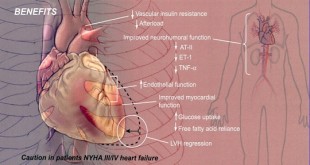
In this week’s Homerun Slides, Dr. Stanley Schwartz reviews pioglitazone as a therapy for both diabetes and cardiovascular issues. Topics include: Pioglitazone in Dysmetabolic Syndrome, Prediabetes, Type 2 Diabetes; Effect of Pioglitazone on Cardiac Mass and Function: and Glitazones (including rosiglitazone) and Cardiac Function…. To download these slides in PowerPoint (.ppt) format, …
Read More »Altered Brain Activation Patterns in Patients with Type 2 Diabetes
Participants performed significantly worse on the working memory tasks…. Type 2 diabetes can be associated with cognitive impairment and the risk of Alzheimer’s disease. No studies have yet shown how type 2 diabetes affects working memory task and is related to brain function. The study used participants from the Beijing …
Read More »