 Diabetes In Control. A free weekly diabetes newsletter for Medical Professionals. News and information for Medical Professionals.
The role of low-dose aspirin in the (primary) prevention of macrovascular events among asymptomatic patients with diabetes is still unclear and the major international guidelines offer differing advice (Figure 20.13). In those patients who have symptoms (e.g. angina or claudication), aspirin confers significant benefits for secondary prevention, but primary prevention is more doubtful, bearing in mind that low-dose aspirin is not without side effects. The ongoing ASCEND trial is evaluating aspirin for primary prevention.

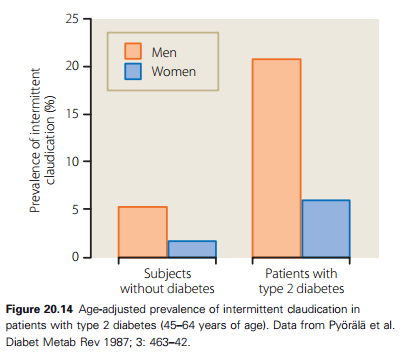
Peripheral arterial disease (PAD) in the legs typically presents with intermittent claudication (i.e. calf pain on walking) (Figure 20.14). Buttock pain may occur if the iliac vessels are affected and PAD may be associated with erectile dysfunction (Leriche’s syndrome). Decreasing claudication distance or rest pain may indicate critical ischemia. PAD in people with diabetes tends to be more diffuse and distal in nature, therefore less amenable to percutaneous intervention (i.e. angioplasty or stenting). People with diabetes have an approximately 16-fold higher risk of lower limb amputation than people without diabetes and about 20% of those with PAD die within 2 years of the onset of symptoms, mostly from myocardial infarction. Because of increased calcification and stiffness, measurements of Ankle Brachial Pressure Index (ABPI; ankle systolic BP divided by brachial systolic BP) may be artificially raised and therefore underestimate the severity of PAD in patients with diabetes. Fibrate therapy has been shown to reduce amputation rates in people with diabetes and PAD.
Coronary heart disease and diabetes
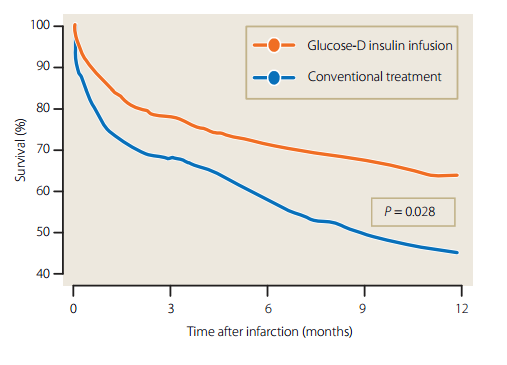
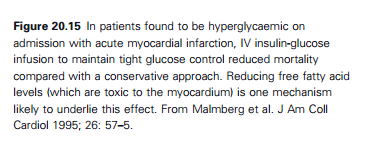
In patients admitted with AMI, blood glucose should be controlled tightly using IV insulin infusion (Figure 20.15). The Diabetes Mellitus Insulin Glucose Infusion in Acute Myocardial Infarction (DIGAMI) study showed a 30% reduction in mortality in patients with diabetes treated with insulin soon after infarction, compared with conventional management. This involves an insulin – glucose solution infused intravenously to maintain blood glucose levels of 7 – 11 mmol/L for at least 24 – 48 hours.
Until recently, the optimum management of patients with diabetes and stable ischemic heart disease was uncertain. In particular, there has been uncertainty about the extent to which asymptomatic patients with diabetes should be screened for coronary artery disease and about the role of revascularization, on prognostic grounds, in patients with stable and/or minimal angina symptoms. The BARI-2D study (a randomized trial of therapies for type 2 diabetes and coronary artery disease) randomized patients with established macrovascular disease who were eligible for either percutaneous coronary intervention (PCI) or coronary artery bypass grafting (CABG). In a 2 × 2 factorial design, patients were assigned to undergo either prompt revascularization or medical therapy, and separately randomized to either insulin sensitization treatment or insulin provision treatment to achieve HbA1c < 7%. Overall, there was no significant difference in the rates of death and major cardiovascular events between patients who had prompt revascularization versus those managed by medical therapy, and nor was there a difference in CV outcomes between the two strategies of HbA 1c lowering. Thus, revascularization is likely to be used mainly for those patients with an acute coronary syndrome and those with unstable or troublesome symptoms despite medical treatment. In the DIAD study, screening of asymptomatic patients with diabetes for coronary disease using myocardial perfusion imaging was of no clinical benefit.

For more information and to purchase this book, just follow this link:
https://www.wiley.com/WileyCDA/WileyTitle/productCd-1405184094.html
Rudy Bilous MD, FRCP, Professor of Clinical Medicine, Newcastle University, Honorary Consultant Endocrinologist, South Tees Foundation Trust, Middlesbrough, UK Richard Donnelly MD, PHD, FRCP, FRACP, Head, School of Graduate Entry Medicine and Health, University of Nottingham, Honorary Consultant Physician, Derby Hospitals NHS Foundation Trust, Derby, UK
A John Wiley & Sons, Ltd., Publication This edition first published 2010, © 2010 by Rudy Bilous and Richard Donnelly. Previous editions: 1992, 1999, 2004
Note: The contents of this work are intended to further general scientific research, understanding, and discussion only and are not intended and should not be relied upon as recommending or promoting a specific method, diagnosis, or treatment by physicians for any particular patient. The publisher and the authors make no representations or warranties with respect to the accuracy or completeness of the contents of this work and specifically disclaim all warranties, including without limitation any implied warranties of fitness for a particular purpose. In view of ongoing research, equipment modifications, changes in governmental regulations, and the constant flow of information relating to the use of medicines, equipment, and devices, the reader is urged to review and evaluate the information provided in the package insert or instructions for each medicine, equipment, or device for, among other things, any changes in the instructions or indication of usage and for added warnings and precautions. Readers should consult with a specialist where appropriate. The fact that an organisation or website is referred to in this work as a citation and/or a potential source of further information does not mean that the authors or the publisher endorse the information the organisation or website may provide or recommendations it may make. Further, readers should be aware that Internet websites listed in this work may have changed or disappeared between when this work was written and when it is read. No warranty may be created or extended by any promotional statements for this work. Neither the publisher nor the authors shall be liable for any damages arising herefrom.