 Diabetes In Control. A free weekly diabetes newsletter for Medical Professionals. News and information for Medical Professionals.
In the DCCT, patients were normotensive at entry. In the UKPDS, however, nearly one-third of patients were hypertensive at entry. Embedded within the trial was a blood pressure-lowering study in which 1,148 hypertensive patients were allocated to either tight (target < 150/ < 85 mmHg) or less tight (target < 180/ < 105 mmHg) control (Figure 14.6). Moreover, the tight control group were further randomized to a regimen based upon either captopril or atenolol.
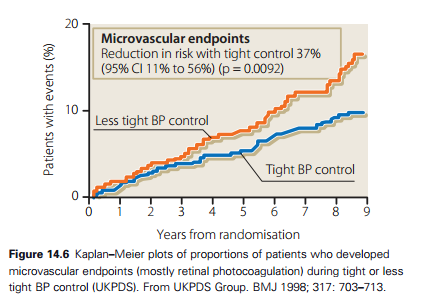
Using the same aggregate microvascular endpoint as for the glycemic control study, there was a reduction of 37% in the tight control group. No difference was seen in those treated with atenolol or captopril. Blood pressure and hyperglycemia have an undoubtedly additive effect on the development of diabetic complications (see Chapter 19).
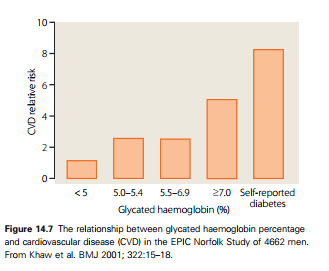
Epidemiological studies show a clear positive relationship between glycemia and macrovascular disease in the general population. For example, in the European Prospective Investigation of Cancer and Nutrition (EPIC) study of 4600 men in the UK, HbA1c was continuously related to cardiovascular mortality from low normal levels ( < 5%; < 31 mmol/mol) to values > 7% ( > 53 mmol/mol) and in people with self-reported diabetes (Figure 14.7).
In the UKPDS, however, there was no significant impact of intensive glycemic control on macrovascular complications although at 10 years there was a 16% reduction in relative risk for myocardial infarction which just failed to reach statistical significance (p = 0.052).
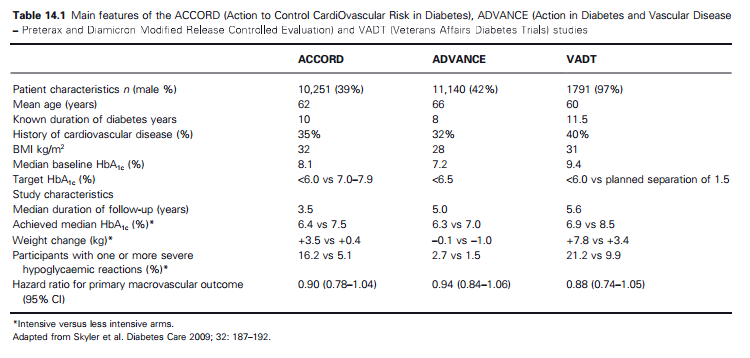
In 2008 the results from three large randomized controlled trials were reported, involving over 23,000 patients with type 2 diabetes who were allocated to a strategy of intensive versus less intensive glycemic control and for whom the main outcome variable was macrovascular disease. These trials showed no benefit of glycemic control on the standard combined cardiovascular endpoint of fatal and non-fatal myocardial infarction and stroke. Moreover, there was a slight increase in cardiac mortality in the intensively treated arm of the ACCORD trial although the total number of myocardial infarctions was almost identical in the intensive and less intensive arms (Table 14.1).
The reason for this discrepancy with the findings from intensive control on microvascular disease probably relates to their pathogenesis. Retinopathy, nephropathy and neuropathy are virtually diabetes specific and therefore hyperglycemia is the main driving force for them. On the other hand, atherosclerosis is more multifactorial and although blood glucose is important, it is only one of many factors which contribute.
The DCCT and UKPDS have published follow-up of the patients who took part in the original studies. At the end of the respective trials, patients were followed but no longer randomized to differing standards of glycemic control.
Most of the DCCT patients took part in the Epidemiology of Diabetes Interventions and Complications (EDIC) Study. Eight years after the end of the DCCT, the relative risk for development of new microalbuminuria was 49% (95% CI 32 – 62%) for intensive control and for clinical or overt nephropathy 85% (68 – 92%). This was despite the fact that the HbA1c levels in the original intensive and conventional groups had almost merged at 8.0 versus 8.2% (64 versus 67 mmol/mol) respectively (p = 0.002).
Similarly, in the UKPDS, a 10-year follow-up at the end of the trial revealed that glycemia was almost identical in the intensive and conventional groups (HbA1c approximately 7.8%; 62 mmol/mol) but there was a remaining relative risk of 0.76 (95% CI 0.64 – 0.89) for the combined microvascular disease endpoint in the intensive arm.
Interestingly, for myocardial infarction there was a significantly lower relative risk of 0.85 (0.74 – 0.97) for the intensively treated group. Moreover, the DCCT/EDIC study also showed a benefit in terms of cardiovascular events in the intensively treated group 8 years after the close of the original study (risk reduction 42%; 9 – 68%) although numbers of events were very small (46 versus 98).
The long-term benefit of intensive control despite the fact that there is no long-term glycemic separation remains unexplained. It is not clear whether there is merely a delay in the intensively treated patients and that ultimately they will catch up or whether this is of long-term clinical benefit. As the DCCT participants were relatively short duration and the UKPDS involved patients with newly diagnosed type 2 diabetes, the message is that the better the glycemic control in the early stages of diabetes, the better the long-term outlook in terms of both micro- and macrovascular complications.

| CASE HISTORY A 65-year-old man with type 1 diabetes for over 50 years attended for annual review. He had few tissue complications apart from minor cheiroarthropathy, minimal background retinopathy and mild angina, well-controlled medically. His control had always been excellent with HbA1c levels never above 7.5% (58 mmol/mol). He had noticed hypoglycemic unawareness, however, and because of this he was commenced on CSII 2 years previously. He is remarkable in other ways. He and his wife had their own family but they have also fostered over 20 children and have a consequently very large and globally dispersed extended family. He says he was always too active and busy not to look after his diet and diabetes. |