 Diabetes In Control. A free weekly diabetes newsletter for Medical Professionals. News and information for Medical Professionals.
Obstetric assessment includes regular ultrasound scans for gestational age, detecting major malformations, monitoring fetal growth and assessing the volume of amniotic fluid. The maternal complications of diabetic pregnancy include pre-eclampsia (hypertension, proteinuria, edema and fetal compromise), polyhydramnios, urinary tract infections, vaginal candidiasis, carpal tunnel syndrome, reflux oesophagitis and preterm labour. The odds ratio for pre-eclampsia is 1.65 for each increase of 1% (11 mmol/mol) in HbA1c level.
Insulin requirements usually increase gradually through the second trimester, coinciding with increasing insulin resistance and food intake, and may continue to increase until 34–36 weeks’ gestation. HbA1c is less precise as an estimate of glycemic control in later pregnancy because of altered red cell survival, possible iron deficiency and increased circulating volume leading to a dilutional fall in haemoglobin concentration. Serum fructosamine is considered by some to be more useful in this situation (see Chapter 9).
In the UK most women with diabetes are delivered at 38, and at the latest 40 weeks, because of the risk of late stillbirth; 35.8% of the CEMACH cohort were delivered before 37 weeks’ gestation. In terms of mode of delivery, for the whole group only 18% had a spontaneous labour, 38.9% were induced and 42.7% had a cesarean section; one-quarter, twice and nearly four times respectively the rates in women without diabetes.
If an early delivery is anticipated then antenatal corticosteroids in high dose are often given in order to facilitate fetal lung maturation. This will inevitably cause hyperglycemia and may even provoke DKA. For these reasons careful monitoring, preferably in hospital, is required and insulin doses increased by 50% or more for 48 hours in order to prevent metabolic decompensation.
During labour, diabetes should be controlled by continuous intravenous infusions of insulin (typically 2–4 U/h) and glucose. Women on CSII can often be managed with adjustments in their infusion rates without the need for intravenous dextrose. After delivery, insulin requirements return almost immediately to pre-pregnancy values or less, and doses should be reduced in order to avoid hypoglycemia. Elective cesarean section is indicated if mechanical problems with vaginal delivery are anticipated (e.g. malpresentation or disproportion), for fetal compromise and severe pre-eclampsia. Breastfeeding requires a further 10%–20% reduction in insulin dose.
Type 2 diabetes
The numbers of pregnant women with type 2 diabetes are increasing, especially in the developing world where this type of diabetes predominates, but they also comprised 27.6% (n = 1041) of the CEMACH cohort in the UK. As a group, these UK women were older and much more likely to be of Afro-Caribbean, Asian or other ethnic minority background than those with type 1 diabetes (48.5% versus 8.5%). Women with type 2 diabetes more often present later in pregnancy and have other risk factors for poor outcome, such as obesity, hypertension and greater age and parity. However, outcome in the CEMACH cohort was no different from type 1 women.
Management of pregnancy in type 2 diabetes is the same as that for type 1 diabetes. In general, women should change to insulin before conception or early in the first trimester. Oral hypoglycemic agents may not achieve sufficiently good glycemic control; moreover, some cross the placenta, may aggravate fetal hyperinsulinemia and are potentially teratogenic (although evidence is conflicting). Glibenclamide (glyburide) does not cross the placenta and although metformin does cross the placenta, there is increasing experience of its use (particularly in gestational diabetes) such that it is currently supported by NICE and so far there have been no safety concerns.
Gestational diabetes
Gestational diabetes mellitus (GDM) is glucose intolerance first recognised in pregnancy. It will therefore include women with impaired glucose tolerance, those with previously unrecognised type 2 diabetes and those who develop type 1 diabetes when pregnant. The earlier in pregnancy it is diagnosed, the more likely it is to be type 1 or 2 diabetes. The pathophysiology is a combination of pregnancy-induced insulin resistance and diminished insulin secretory capacity. Some studies suggest that women who develop GDM have demonstrable deficiencies in beta-cell function prior to pregnancy. There are no universally agreed diagnostic criteria, but the World Health Organization definition (which is similar to IGT outside pregnancy, i.e. plasma glucose > 7.8 mmol/L 2 hours after a 75g oral glucose load) is used widely and forms the basis of NICE guidance in the UK. However, this definition is likely to change as a result of the Hyperglycemia and Adverse Pregnancy Outcomes (HAPO) Study which has shown a linear relationship between fasting and post-glucose load plasma glucose for birthweight (OR for birthweight > 90th centile is 1.32 for each 0.4 mmol/L increase in fasting plasma glucose and 1.38 for each 1.3 mmol/L increase in 2-hour post 75 g oral glucose load) (Table 27.1). There was no cut-off point. An expert panel has reviewed the data and produced an international consensus on diagnostic plasma glucose levels (Table 27.1). The implication of these new criteria is that up to 18% of women may now meet the diagnostic criteria for GDM (based on the HAPO study).

Because of the lack of agreed diagnostic criteria, true prevalence is hard to ascertain but it is said to affect 1%–14% of all pregnancies in the USA and 3%–5% in the UK, although this varies considerably by ethnicity (white Europid ∼ 0.4%; Asian 7.3%).
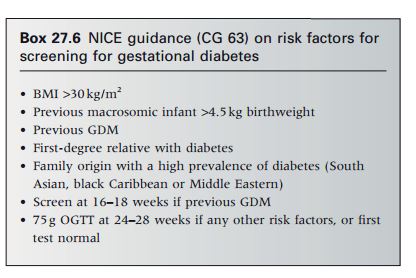
The publication of the Australian Carbohydrate Intolerance Study in Pregnant Women (ACHOIS) demonstrated for the first time that intervention with intensive glucose control could reduce complications for the mother and child. As a result, there is now an intensive debate about the benefit of screening, its timing, diagnostic criteria and treatment. Neither NICE nor the US Preventive Services Task Force currently recommends population screening, but most national guidelines suggest a targeted approach even though there are data to suggest that this will miss a significant number of cases. A meta-analysis of 20 studies has shown an increasing OR for GDM for increasing maternal weight (2.14, 3.56 and 8.56 for the overweight, obese [BMI > 30 kg/ m2] and severely obese [BMI > 40 kg/m2] respectively).
Treatment is controversial, but the glycemic targets are similar to those for established diabetes. Dietary assessment and carbohydrate reduction to 35%–40% of total daily calorie intake (30% if obese) is recommended by the ADA although there is little firm supportive evidence. Other lifestyle advice in terms of increasing exercise should be given and a 2-week trial of both with home blood glucose monitoring is recommended. If glycemic targets are not achieved then treatment with glibenclamide (up to 20 mg/day, and dosage up to 3 times daily 30–60 mins before meals), metformin (up to 2500 mg/d but starting at 500 mg/d) or acarbose (50 mg tds) should be considered. There are no trial data for combination therapy. If targets are still not reached then insulin should be started.

There is no evidence-based guidance on preferred mode of delivery, but because many of the babies are large there is a risk of birth trauma and inevitably the caesarean section rate is high. Neonates have a similar risk for the same medical problems as for the offspring of mothers with pregestational diabetes. Moreover, macrosomic infants have a twofold risk for childhood obesity and an increased odds for developing diabetes and cardiovascular disease in adulthood. It is not known if prevention of macrosomia will reduce these risks; prospective and long-term studies will be required to settle this question.
Diabetes usually resolves after delivery (except in those with type 1 or 2 diabetes) but is very likely to recur in subsequent pregnancies, and the lifetime risk of developing type 2 diabetes over the subsequent 10 years is linear at 35%–60%, depending on the background risk of the population. Women who have had GDM therefore need health education about reducing weight, increasing exercise and improving their cardiovascular risk profile.
For more information and to purchase this book, just follow this link:
https://www.wiley.com/WileyCDA/WileyTitle/productCd-1405184094.html
Rudy Bilous MD, FRCP, Professor of Clinical Medicine, Newcastle University, Honorary Consultant Endocrinologist, South Tees Foundation Trust, Middlesbrough, UK
Richard Donnelly MD, PHD, FRCP, FRACP, Head, School of Graduate Entry Medicine and Health, University of Nottingham, Honorary Consultant Physician, Derby Hospitals NHS Foundation Trust, Derby, UK
A John Wiley & Sons, Ltd., Publication This edition first published 2010, © 2010 by Rudy Bilous and Richard Donnelly. Previous editions: 1992, 1999, 2004
Note: The contents of this work are intended to further general scientific research, understanding, and discussion only and are not intended and should not be relied upon as recommending or promoting a specific method, diagnosis, or treatment by physicians for any particular patient. The publisher and the authors make no representations or warranties with respect to the accuracy or completeness of the contents of this work and specifically disclaim all warranties, including without limitation any implied warranties of fitness for a particular purpose. In view of ongoing research, equipment modifications, changes in governmental regulations, and the constant flow of information relating to the use of medicines, equipment, and devices, the reader is urged to review and evaluate the information provided in the package insert or instructions for each medicine, equipment, or device for, among other things, any changes in the instructions or indication of usage and for added warnings and precautions. Readers should consult with a specialist where appropriate. The fact that an organisation or website is referred to in this work as a citation and/or a potential source of further information does not mean that the authors or the publisher endorse the information the organisation or website may provide or recommendations it may make. Further, readers should be aware that Internet websites listed in this work may have changed or disappeared between when this work was written and when it is read. No warranty may be created or extended by any promotional statements for this work. Neither the publisher nor the authors shall be liable for any damages arising herefrom.