 Diabetes In Control. A free weekly diabetes newsletter for Medical Professionals. News and information for Medical Professionals.
Accelerated fetal growth, which leads to a macrosomic, large-for-gestational-age infant, is caused by enhanced delivery of glucose and other nutrients to the fetus. This stimulates the islets and induces fetal hyperinsulinemia, which promotes abdominal fat deposition, skeletal growth and organomegaly. Complications for these large babies include birth trauma and neonatal hypoglycemia and hypocalcemia. Despite being large for gestational age, the macrosomic fetus tends to be dysmature and is prone to the respiratory distress syndrome at birth. Rates of macrosomia depend upon the definition; in the CEMACH over 50% of babies were above the 90th centile birth weight. Using a definition of 4 kg, 21% of babies were macrosomic compared to 11% in women without diabetes (Figure 27.2). Interestingly, rates are similar in type 1, type 2 and gestational diabetes and relate to glycemia in the latter half of pregnancy.

Pre-pregnancy counseling
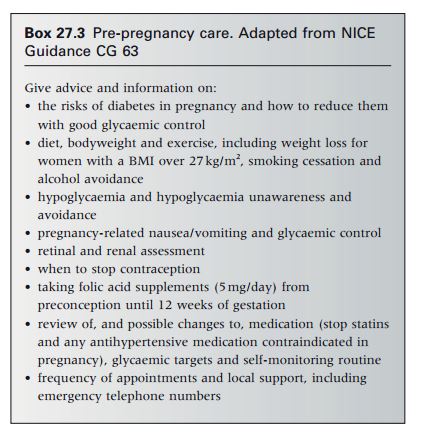
Management of pregnancy in women with diabetes begins with preconception advice and counseling (Box 27.3). This includes explanation of the risks of pregnancy and the requirements for successful pregnancy, including frequent clinic visits beginning as soon as possible after conception, optimised metabolic control, stopping both smoking and drinking alcohol, and a folate-rich and supplemented diet (5 mg/day — a higher dose than usually recommended for non-diabetic pregnancy). Potentially teratogenic drugs should be replaced with safer alternatives — ACE inhibitors are contraindicated, for example. Outpatient preconception care of women with diabetes is thought to reduce congenital anomalies by about two-thirds.
Management of diabetic pregnancy
NICE guidance for the management of pregnancy in pregestational diabetes includes optimisation of glycemic control, aiming for a fasting plasma glucose concentration 3.5–5.9 mmol/L, a 1-hour postprandial peak < 7.8 mmol/L and an HbA 1c < 6.1% (44 mmol/mol). Virtually all women with type 1 diabetes require a basal-bolus insulin injection regimen to achieve strict glycemic control, with at least four times daily blood glucose self-monitoring. The choice of insulin is controversial. There are no prospective trials that establish the safety of the new long-acting analogues, but neither are there many for older insulins. Current guidance suggests that long-acting analogues should not be started in pregnancy but may be continued after discussion with the pregnant woman. Neutral protamine Hagedorn (NPH) should be used if a change is requested or a new longer acting preparation is started. The short-acting analogues aspart and lispro are safe to continue. Continuous subcutaneous insulin infusion (CSII–insulin pump therapy) is an alternative option in those who have difficulty achieving good control on multiple injections without unacceptable hypoglycemia, although a meta-analysis of six studies showed no advantage over multiple injection therapy. Suitably powered prospective trials are required in order to determine optimum management of glycemia in pregnancy.
Screening for complications is necessary, since pregnancy can worsen renal function in women with established nephropathy (serum creatinine > 124 μmol/L or estimated GFR (eGFR), < 45 mL/min/1.73 m2); consequently, blood pressure should be controlled carefully (e.g. with nifedipine, methyldopa or labetalol). Increasing proteinuria and hypertension are common in worsening nephropathy, but can be difficult to distinguish from pre-eclampsia in later pregnancy (see below). eGFR is not valid in pregnancy so timed creatinine clearances are necessary to monitor declining renal function. Retinopathy may also deteriorate rapidly during diabetic pregnancy, especially when glycemic control is improved suddenly. Increased frequency of surveillance and early photocoagulation should be considered in high-risk patients in early pregnancy or even before conception.
