 Diabetes In Control. A free weekly diabetes newsletter for Medical Professionals. News and information for Medical Professionals.
Encapsulating insulin producing cells in tiny seaweed bubbles and injecting them into people with type 1 diabetes could one day remove the need for daily insulin injections.
Professor Bernie Tuch of the University of New South Wales launched a trial of the technology this week, using capsules made from the seaweed derivative alginate and measuring just 300 micrometres across.
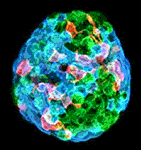 Researchers have put insulin producing cells like this into tiny capsules as a treatment for type 1 diabetes (Image: NIH) |
Tuch says if the trial works, it will mean that insulin producing cells, or islets, can be transplanted, effectively reversing type 1 diabetes, without the need for immunosuppressive drugs.
This is because the capsules protect the transplanted cells from being sought out and destroyed by the body’s immune system.
The capsules also contain tiny holes that let the insulin flow out while allowing oxygen and nutrients in. "The concept of the seaweed is that it forms a coating around the islets … with holes that are small enough to prevent immune cells entering," Tuch says.
The trial, involving a 51-year woman who was diagnosed with type 1 diabetes 40 years ago, is the first of its kind in Australia.
During the half-hour procedure the woman was injected with 75,000 capsules containing a total of around 200,000 islet cells. The islets had been isolated from a cadaver and put into the capsules in a procedure Tuch compares to blowing soap bubbles.
"There’s the alginate, there’s your cells and there’s air," he says.
"You blow the air and the alginate and the cells together and it’s like blowing soap bubbles; they come out with the cells inside the capsules."
The capsules were injected into the patient’s abdomen where it’s hoped they will start producing insulin within 24 hours, allowing her to slowly begin reducing her insulin injections.
Tuch says one injection could potentially last a lifetime although it’s not yet known whether the current patient will need extra injections.
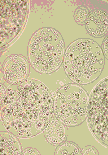 Microcapsules containing insulin producing cells (Image: DTU) |
What could go wrong?
Immunologist Dr Bronwyn O’Brien, who is working with a team from the University of Technology Sydney to genetically engineer liver cells so they produce insulin, says Tuch’s method is promising but may have complications.
"In practice one of the big problems is that … often islets that are in the centre of the capsule become hypoxic, they’re not getting oxygen, and they die," she says.
"The implications would be the cells would break up into possibly small enough pieces that could leave the capsule."
There’s also a chance that immune cells could grow around the outside of the capsules, blocking the flow of insulin, she says.
And while the pores in the capsules are big enough to keep T cells and antibodies out, there’s still a chance that cytokines, the so-called messengers of the immune system, will slip through and produce an inflammatory response.
Tuch acknowledges this risk and says the patient received anti-inflammatory drugs as a precaution.
"We don’t anticipate there is going to be a major inflammatory response but if they do get in then the islets may be destroyed," he says.
The concept of microencapsulation as a means of avoiding rejection drugs could apply to any transplant involving cells, Tuch says, and in particular stem cell therapies.
===========================
Advertisement
Multivitamin Supplements & Diabetes:
Recent research confirmed that taking a daily multivitamin and mineral supplement has a positive impact on the quality of life for people with diabetes. So regularly taking a multiple is an easy choice, but for most finding the right one to trust with their health proves to be a more difficult matter. alpha betic(r) is uniquely balanced to meet the special dietary needs of people with diabetes and those predisposed to diabetes. alpha betic(r) contains 23 important nutrients in safe and balanced doses, with no copper.
For more information: Click Here
https://www.diabetesincontrool.com/ads/alphabetic/dest.php