 Diabetes In Control. A free weekly diabetes newsletter for Medical Professionals. News and information for Medical Professionals.
Risk of death, congestive heart failure or major adverse cardiovascular events was higher in patients who took muraglitazar. This information comes after the FDA advisory committee voted to recommend approval.
Further concerns regarding the safety profile of muraglitazar have surfaced after a newly-published study established that the drug may be associated with an increased risk of death and cardiovascular events.
Although an FDA advisory committee voted to recommend approval for muraglitazar (Pargluva, Bristol-Myers Squibb/Merck) in September, a study published in the Journal of the American Medical Association by researchers at the Cleveland Clinic found that the risk of adverse events in patients treated with the drug may be higher than previously believed.
The study, led by Steven Nissen, MD, compared muraglitazar with placebo or pioglitazone as a treatment for type 2 diabetes. According to Nissen and his colleagues, patients treated with muraglitazar had an excess risk of death, congestive heart failure and major adverse cardiovascular events, including myocardial infarction, stroke or transient ischemic attack. Nissen is the medical director of the Cleveland Clinic Cardiovascular Coordinating Center.
The researchers said these new findings should be taken into account before the FDA officially approves muraglitazar.
“This agent should not be approved to treat diabetes based on laboratory end points until safety is documented in a dedicated cardiovascular events trial,” they wrote.
Nissen and his colleagues reviewed phase-2 and phase-3 clinical trials of muraglitazar. Documents relating to these trials were released under public disclosure laws prior to the FDA advisory committee meeting when muraglitazar was recommended for approval.
All trials included in the review were prospective, randomized, double-blind, multicenter studies. All patients enrolled had type 2 diabetes and HbA1c levels between 7% and 10%.
“A drug that lowers blood sugar and improves lipids but increases the risk of morbidity and morality is not acceptable for rapid approvals, ” Steven Nissen, MD
Patients were randomized to receive various doses of muraglitazar, pioglitazone or placebo as monotherapy or in combination with metformin or glyburide. The various trials ranged from 24 to 104 weeks and included a total of 3,725 patients.
The review demonstrated that the risk of death, myocardial infarction or stroke was more than twice as high in patients treated with muraglitazar compared to those treated with placebo or pioglitazone.
Among the 2,374 patients assigned muraglitazar, 35 (1.47%) experienced a major adverse event. Among the 1,351 patients given placebo or pioglitazone, nine (0.67%) experienced a major adverse event.
A further analysis that also examined the risk of congestive heart failure and transient ischemic attack demonstrated that the incidence rate was 2.11% for patients assigned muraglitazar and 0.81% for patients assigned placebo or pioglitazone.
With the addition of congestive heart failure and transient ischemic attack, a total of 50 patients in the muraglitazar group and 11 patients in the placebo or pioglitazone group experienced a major adverse event. 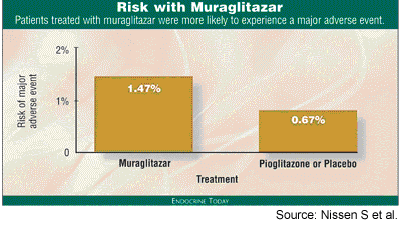
“I have proposed a large cardiovascular outcomes study to determine the relative safety of this drug,” he said. “Patients should not be treated with muraglitazar until safety is demonstrated in an appropriate trial.”
Nissen said that, particularly since there are alternative treatment options, hesitancy to approve muraglitazar may be in the best interest of patients. “A drug that lowers blood sugar and improves lipids but increases the risk of morbidity and mortality is not acceptable for rapid approval,” he said. “There are excellent alternatives that are proven safe and effective.”
In response to the increasing concerns about the safety profile of muraglitazar, Bristol-Myers Squibb announced that it could take up to five years to complete the additional studies needed to better assess the drug’s safety. In a press release, the company said it would continue talks with the FDA and would “consider a range of options including conducting additional studies or terminating further development of muraglitazar.”
Nissen S, Wolski K, Topol E. Effect of muraglitazar on death and major adverse cardiovascular events in patients with type 2 diabetes mellitus. Published online. JAMA. 2005;249.20.
=============================
The 10,000 STEP STUDY:
"The Results". A simple answer to a difficult problem.
https://www.diabetesincontrol.com/modules.php?name=News&file=article&sid=2001
=============================
Please update your profile, click here to keep your newsletter free.
https://www.diabetesincontrol.com/surveys/index.php