Diabetes In Control. A free weekly diabetes newsletter for Medical Professionals. News and information for Medical Professionals.
Certain mild neurologic findings in childhood are associated with adult obesity, according to the results of a longitudinal birth cohort study. Possible way to predict future risk for diabetes?
"Obesity in adults is associated with cognitive impairment and dementia, and this is assumed to be a consequence of obesity or obesity related processes such as secretion of bioactive hormonal compounds, altered insulin signalling, diabetes, hypertension, and other cardiovascular disease processes," write Walter Osika and Scott M. Montgomery, from Örebro University Hospital in Örebro, Sweden. "However, some relevant processes begin in earlier life, potentially with different mechanisms. Obese adults and those with adult onset type 2 diabetes mellitus may already have lower levels of cognitive function in childhood, consistent with a subtle developmental impairment."
The goal of this study was to determine whether measures of physical control and coordination as markers of neurologic function in childhood are associated with obesity in adults. As part of the national child development study in Great Britain, the investigators studied 11,042 people born during 1 week in 1958, with a main outcome measure of obesity (body mass index [BMI] ≥ 30 kg/m2) at age 33 years.
In children at age 7 years, teacher reports from 7990 cohort members showed that poor hand control, poor coordination, and clumsiness "certainly applied" more often in those who would be obese adults. Adjusted odds ratios (ORs) were 1.57 (95% confidence interval [CI], 1.13 – 2.20; P = .008) for poor hand control, 2.30 (95% CI, 1.52 – 3.46; P < .001) for poor coordination, and 3.91 (95% CI, 2.61 – 5.87; P < .001) for clumsiness.
At age 11 years, 6875 participants had clinician-administered evaluations with continuous scores. In this group, poorer function was associated with later obesity. Adjusted ORs (change in risk per unit increase in score) were 0.88 (95% CI, 0.81 – 0.96; P = .003) for copying designs, 0.84 (95% CI, 0.78 – 0.91; P < .001) for marking squares, and 1.14 (95% CI, 1.06 – 1.24; P < .001) for picking up matches (for this test, a higher score indicates worse function). After additional adjustment for contemporaneous BMI at age 7 or 11 years, these associations remained statistically significant.
Limitations of this study include inability to identify specific measures of neurologic function, attrition greatest in more disadvantaged groups that also tend to contain a higher proportion of obese cohort members, and the possibility that other environmental or individual characteristics could explain the associations.
"This study cannot identify the specific biological processes linking poorer physical control and coordination in childhood with later obesity," the study authors write. "However, it suggests that some of the processes associated with poorer neurological function in obese adults have their origins in childhood."
Obese adults may have a history of lower levels of cognitive function in childhood, suggesting that neurocognitive development and obesity may share common pathways reflecting early biological processes relevant to neurologic function. Alternatively, adult obesity and tests of cognitive function are both directly affected by social and cultural factors, and these may overlap, contributing to both conditions.
This study looked at the relationship between tests of physical control and coordination in children and obesity in adults. The investigators suggest that this will highlight the importance of a life course approach in explaining some aspects of poorer neurologic function in obesity.
Practice Pearls:
- In a longitudinal cohort study, teacher reports showed that poor hand control, poor coordination, and clumsiness in children at age 7 years were associated with obesity in adulthood, even after adjustment for contemporaneous BMI or after adjustment to reduce the possibility that deviant behavior affected the teachers’ perceptions of children.
- Clinician-administered evaluations with continuous scores in children at age 11 years showed that poorer motor function was associated with later obesity, even after adjustment for BMI and markers of pubertal stage.
BMJ. Published online August 12, 2008.
===============================
DID YOU KNOW:
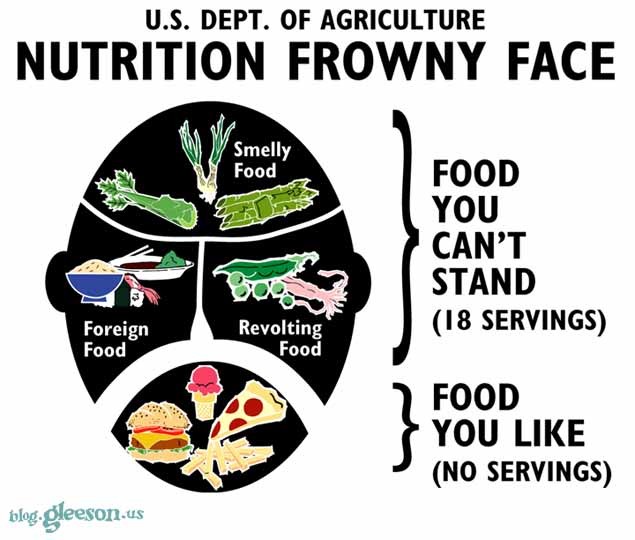
New USDA Food Groupings Chart shows things the way many of our patients think of them. Enjoy this chuckle!! Click to enlarge