 Diabetes In Control. A free weekly diabetes newsletter for Medical Professionals. News and information for Medical Professionals.
We ran into Dr. Sheri Colberg, Ph.D., FACSM at ADA in San Francisco and we were discussing the success patients feel when they do something physical and how many medical professionals have used her printouts to help their patients. This week she brings us Lower-body resistance training exercises: One-leg press and squats. Add this to your collection of handouts for patients.
Lower-body resistance training exercises: One-leg press and squats
By Sheri Colberg, Ph.D., FACSM
 By way of reminder, your main lower-body muscles include the quadriceps (“quads”) and hamstrings on the front and back of your thighs, respectively, adductors (inner thigh), gluteus muscles (“gluteals” or buttocks), and calf muscles (gastrocnemius and soleus). As with the upper-body exercises, working multiple groups of muscles first and then focusing in on specific groups is the best practice for lower-body workouts as well.
#1: One-leg press
Equipment needed: resistance band, (optional) exercise mat
Main muscles worked: quads, gluteals, calves
Directions:
- Sit on the floor with your legs out in front of you, knees slightly bent.
- Hold one end of the resistance band in each hand and place it around the sole of your right foot with your right knee fully bent.
- Straighten your right leg (without locking your knee) while pulling on both sides of the resistance band.
- Continue to pull against the resistance band as you return your knee to the bent position.
- Repeat the exercise with your left leg.
- Alternately, tie the resistance band in a circle around the leg of a chair, then sit on the chair, place the sole of your foot inside the other end of the band, and straighten your leg almost fully out.
Starting Position Midway Position
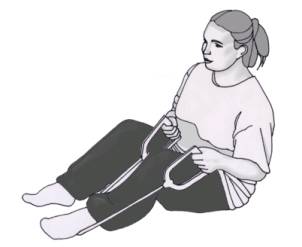
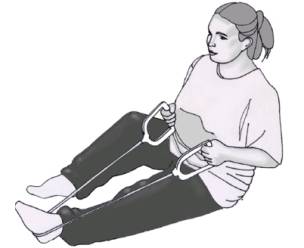
© 2006 and 2007 by Sheri Colberg and Patrick Ochs
#2: Squats
Equipment needed: dumbbells or resistance band
Main muscles worked: quads, hamstrings, gluteals, calves
Directions:
- Stand with a dumbbell in each hand and your feet shoulder-width apart, with your toes pointing slightly out to the side.
- If you’re using a resistance band, tie both ends of your band onto a straight bar or broom handle, which is placed squarely across your shoulders with the loop of the tied band placed under your feet.
- Keep your body weight over the back portion of your foot rather than your toes; if needed, lift your arms out in front of you to shoulder height to balance yourself.
- Begin squatting down but stop before your thighs are parallel to the floor (at about a 70-degree bend), keeping your back flat and your abdominal muscles firm at all times.
- Hold that position for a few seconds before pushing up from your legs until your body is upright in the starting position.
- Do squats with your back against a smooth wall if needed to maintain your balance.
Starting Position Midway Position
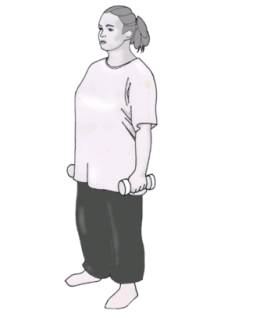
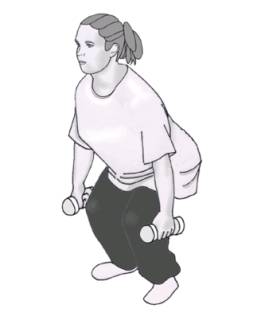
© 2006 and 2007 by Sheri Colberg and Patrick Ochs
In two weeks, this column will give you some additional lower-body resistance training exercises. For more information, consult The 7 Step Diabetes Fitness Plan: Living Well and Being Fit with Diabetes, No Matter Your Weight by Sheri Colberg and The Science of Staying Young by John E. Morley and Sheri Colberg (2007). Also, visit her web site at www.shericolberg.com for additional articles and access to her fitness blog.