 Diabetes In Control. A free weekly diabetes newsletter for Medical Professionals. News and information for Medical Professionals.
Richard S. Beaser, MD,
Edward S. Horton, MD and
Catherine A. Mullooly, MS, RCEP, CDE

The weeks excerpt answers the following questions:
- How to adjust insulin for activity
- What is the "lag effect"
- Which snack foods are best for exercise
While promoting physical fitness is an important part of therapy for people with type 1 diabetes, proper adjustment of the insulin dose and food consumption is essential to maintain proper diabetes control. With such adjustments, these individuals have the potential to perform as well in sports or other activities as those who do not have diabetes.
Through proper diabetes management training, patients can develop the skills to more effectively self-manage a fitness program. Often there can be great benefit from consultation with an exercise physiologist experienced in advising people with diabetes. With input from these specialists, patients can develop proper fitness routines, and become skilled in adjusting food and insulin to maintain smooth glucose control. It is not only the stereotypic young, athletic individual who should consult with an exercise physiologist. Physical activity, tailored to individual abilities and medical conditions, is of great benefit to all people, including those in the later years of life.
Even if an exercise physiologist is not consulted, a person with type 1 diabetes can begin a fitness program. However, there are a few key points for him or her to keep in mind when exercising. Like people with type 2 diabetes, those with type 1 diabetes must avoid physical exertion if their diabetes is out of control. For people with type 1, even more than those with type 2, elevated glucose levels, particularly if not due to a hypoglycemic event and rebound hyperglycemia, can reflect an insulin insufficiency. Exercising with hyperglycemia and with the presence of ketones may lead to increases in blood glucose levels or a worsening of the ketosis. A fasting blood glucose level over 250–300 mg/dl, especially with the presence of ketones, should be a warning not to be physically active until the abnormality is corrected.
The insulin dose and food consumption may need adjustment to prevent hypoglycemia during or after a workout session. By keeping careful records of all parameters, including the differing types of physical activity, a patient can estimate a dose adjustment that works for him or her based on the duration, intensity, and frequency of exertion (see Table 6-6). Subsequently, through a sequential process of applying problem-solving skills, fine-tuning adjustments can be made to hone in on the proper balance of insulin, food, and activity that can be quite effective in maintaining glucose control. It should be emphasized that the development of this routine requires active patient participation in the process. Members of the healthcare team should recommend methods to estimate adjustments; but through actually trying various adjustments, many patients can self train themselves to be quite skilled in management of the fitness program.

The importance of record-keeping cannot be emphasized enough. Detailed records of the blood glucose levels help patients determine for themselves which changes in the insulin dose and/or food consumption compensate properly for a given amount of physical exertion. Blood glucose checking before and after physical exertion is a minimum requirement. It is also helpful to check blood glucose during a workout session to look for hypoglycemia, the symptoms of which may be masked by the sweating caused by the activity. Checking a few hours after the workout session can also be useful in gauging the strength of potential lag-effect, the post-exertion hypoglycemic tendency as glucose stores in muscle and liver are being replenished. In some patients, the use of CGM may be useful to determine periods of either hyper- or hypoglycemia during and after exercise that would otherwise go undetected. Physical exertion can have differing effects on glucose control depending on the time of day that it is performed. Specifically, at different times of day, various insulin doses may be at differing percentages of their peak activity (see Table 6-6). Temporal proximity to food consumption also plays a role.
For example, physical exertion should be done with caution just after insulin injections are given. This would be particularly true for the rapid acting insulins (aspart, glulisine, or lispro). Many people find that the best time to perform the fitness workout is at least an hour after a meal. Having reviewed all of these suggestions for optimal timing, however, many pragmatic healthcare professionals suggest that the best time to do the fitness workout is the time that the patient will actually be able to DO that activity! Insulin or snack adjustments to compensate for the diabetes can be worked out for almost any timing.
Low-Level Physical Exertion
Some reduction of the insulin dose that covers the period of physical exertion may be necessary when a person starts a fitness program. However, once the program has become part of the routine, occurring at least 3 to 4 times per week, people with ideal body weight who are not trying to lose weight often do not need to adjust their insulin for occasional, moderate physical exertion of short duration (under 30 minutes). For more intense or prolonged periods of exertion, however, insulin dose reduction or a snack may be needed, especially if the activity is performed more than 1 or 2 hours after a meal. Fifteen grams of carbohydrate, for example, should be enough for 30 to 60 minutes of moderate physical exertion such as "friendly" tennis, leisurely biking, or walking. People should get into the habit of checking their glucose level prior to each workout session and adjusting the snack based on the result of that glucose check. The lower the blood glucose level at the start of activity, the more food may be needed. In a relatively short time, most can become quite skillful in snack titration.
Vigorous Physical Exertion
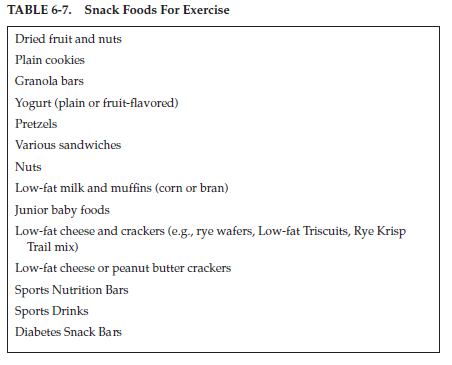
For more vigorous activity, the preferred accommodation would also be to reduce the insulin doses. More food, perhaps half a sandwich (15 grams of carbohydrate and 7 to 8 grams of protein) can also be used to cover the first hour of activity. Table 6-7 lists some snack food options. Some of these are higher in fat than those commonly recommended for usual snacks. Fat slows intestinal absorption of food, leading to more prolonged and even availability of the food-supplied energy during the activity.
When the physical activity is unexpected and adjustments of insulin or calculated consumption of foods to provide even energy has not occurred, it is certainly acceptable, indeed recommended, to consume concentrated carbohydrates such as sugar-containing tonic or juices in anticipation of sudden bursts of activity. However, since these are short-lasting, a carbohydrate and protein-containing snack may still be required in order to maintain the blood glucose throughout the activity.
Longer Physical Exertion Sessions
When longer periods of activity are anticipated, insulin dose reductions are the primary means of compensatory adjustment. Initial estimates of the dose reduction may be off-target, but careful record-keeping, with notations as to the dose adjustments and the reasons for them, will allow later review of a number of such events to gauge accuracy and hone in on a more accurate dose adjustment estimate.
Supplemental snacks may also be used. However if relied upon to excess, the benefits of activity for weight management may be ameliorated. Snacks may be used, however, if the decision to undertake the activity occurs after the insulin dose has been taken. In such instances, snacks at 60-minute intervals may be required. These snacks can consist of 15 grams of carbohydrate plus 7 to 8 grams of protein. Snacking in this manner may be utilized, if needed, for all-day activities such as cross-country skiing or hiking, and patients should be told to take appropriate types and quantities of food along. Snack quantities may vary depending on the time of day and the amount of insulin that may be having its peak activity. Again, a problem-solving approach combined with good record-keeping will help determine the optimal quantities. For some very vigorous all-day activities, significantly more calories may be needed if sufficient reductions of insulin dose have not been made. For example, backpacking may require 5000 to 6000 calories per day, and the increase should be spread over the meals as well as the snacks.
Fluids are also quite important. A great deal of fluid may be lost as sweat, so sufficient intake prior to starting physical exertion is recommended. Water is recommended because it is most easily absorbed. Fluids are especially important for prolonged activity on a warm day or for activities that cause much sweating. Dehydration can worsen diabetes control.
An overweight person with type 1 diabetes may undertake a fitness program to lose weight. When weight loss is the goal, it is important to reduce the insulin doses so that extra snacking can be avoided. Again, trial and error, with frequent checking of blood glucose levels, will help determine the quantity of insulin reduction for a given amount of activity. Remember, too, that the "lag effect" can result in post-exertion hypoglycemia, so that more than one insulin dose may need to be reduced.
With careful attention to parameter adjustment, people with diabetes can enjoy the benefits of a fitness program without any deterioration of glucose control. It is important that people not become discouraged if the adjustment solutions are not evident early-on in the development of their activity routine. Encouragement, support from skilled educators, and patience will often bear fruit. However, when control cannot be maintained in concert with a fitness program, it may be an indication of the need to redesign the insulin program so that it more closely mimics normal insulin patterns. Chapters 9 and 10 detail methods to make such changes.
American College of Sports Medicine. Exercise Management for Persons with Chronic Diseases and Disabilities. Champaign, Il: Human Kinetics; 2003.
Borg, G. Borg’s Perceived Exertion and Pain Scales. Human Kinetics: Champaign, IL, 1998.
Steppel JH, Horton, ES. Exercise in patients with diabetes mellitus. In Kahn CR, Weir GC, King GL, et al, eds. Joslin’s diabetes mellitus. 14th ed. Philadelphia: Lippincott Williams & Wilkins, 2005 [649–657]
Copyright © 2010 by Joslin Diabetes Center. All rights reserved. Reprinted with permission. Neither this book nor any part thereof may be reproduced or distributed in any form or by any means without permission in writing from Joslin. Note: Joslin does not endorse products or services.
You can purchase the updated 2nd Edition of JOSLIN’S DIABETES DESKBOOK at:
https://www.joslin.org/jstore/books_for_healthcare_professionals.html
Please Note: Reasonable measures have been taken to ensure the accuracy of the information presented herein. However, drug information may change at any time and without notice and all readers are cautioned to consult the manufacturer’s packaging inserts before prescribing medication. Joslin Diabetes Center cannot ensure the safety or efficacy of any product described in this book.
Professionals must use their own professional medical judgment, training and experience and should not rely solely on the information provided in this book to make recommendations to patients with regard to nutrition or exercise or to prescribe medications.
This book is not intended to encourage the treatment of illness, disease or any other medical problem by the layperson. Any application of the recommendations set forth in the following pages is at the reader’s discretion and sole risk. Laypersons are strongly advised to consult a physician or other healthcare professional before altering or undertaking any exercise or nutritional program or before taking any medication referred to in this book.