 Diabetes In Control. A free weekly diabetes newsletter for Medical Professionals. News and information for Medical Professionals.
Richard S. Beaser, MD,
Edward S. Horton, MD and
Catherine A. Mullooly, MS, RCEP, CDE

The week’s excerpt answers the following questions:
- What the four necessary factors are in a fitness program
- The formula to use to estimate individuals maximum heart rate
- How to use the Karvonen formula
- Which is more important, intensity or duration
- The minimum ideal activity level….
A prescription for a fitness program should take into account four things:
Aerobic activities are usually the preferred form of physical activity, and walking is the most commonly chosen of the types of aerobic activities. If this weight-bearing activity is not well tolerated, then other options can be utilized. Non-weight-bearing alternatives include armchair exercise, aqua aerobics, arm ergometry, rowing and stationery cycling.

Strength training may also be included in a physical fitness program if no contraindications exist. These types of movements improve muscle mass as well as contribute to improved posture, balance, gait and ease of daily activities. People with significant physical limitations can benefit from gentle strengthening exercises, such as walking, stair climbing and specific leg muscle strengthening exercises and the use of elastic exercise bands, to improve activities of daily living.
Physical movements to improve flexibility may also be recommended. These activities may be particularly useful for people who, with aging, have diminished flexibility. Yoga, tai chi and range-of-motion exercises are some examples.
Table 6-3 lists some appropriate activities for people with diabetes. Choices will vary depending on ability, personal interest, climate, and available facilities. All fitness program recommendations should be individualized based on physical condition, medical conditions, and personal interest and goals.
The intensity of physical exertion is determined by monitoring the heart rate and other signs of stress. Heart rate is measured by taking the pulse at the carotid artery, the temple, or the radial artery or by placing the hand on the chest. The heart rate should be measured within 5 seconds of stopping activity. People who are just starting a fitness program should also monitor their pulse rate four or five times during a physical activity session. Suggest to patients that that they can estimate their pulse rate by measuring it for 10 seconds and multiplying by 6, which will give them the heart rate per minute. Alternatively, affordable and accurate heart monitors are now available for use during physical activity.
Remind patients who use medications such as beta-blockers that these drugs may affect the heart rate. Also, the cardiac effects of diabetic autonomic neuropathy may affect the heart rate. In circumstances such as these, the pulse rate may underestimate the actual stress on the body, and caution must be taken. In these instances, the "Ratings of Perceived Exertion Scales" described below can be used.
Other signs of stress include labored breathing, light-headedness, angina, or a very pale face.
It is important that the person performing the fitness program be advised to work to the correct intensity in order to insure safety, as well as to maximize enjoyment. Increasing the heart rate as little as twenty to thirty beats per minute above the resting rate can provide significant health benefits.
The acute and chronic effects of exercise and improvements in insulin action and enhanced glycemic control are in part determined by the intensity and duration of physical activity. There are several methods one can use when determining the appropriate level of intensity with physical exertion or of the physical fitness program:
- Percent of HRmax Method
Heart rate is used as a guide to set exercise intensity because of the relatively linear relations between HR and percentage of maximal oxygen consumption (%VO2max). One of the oldest methods of setting the target HR range during exercise uses maximal HR (HRmax) determined during a progressive exercise test whenever possible or age calculated HRmax.
Table 6-4. Exercise Heart Rate Calculation

Various formulas are used to estimate individuals maximum heart rate based upon age, but maximum heart rate vary significantly between individuals. The most common formula used (HRmax = 220 – age) is easy to remember and calculate, but the variance for any given age is considerable (1 SD – 10-12 beats per min.) The American College of Sports Medicine (ACSM) recommends an intensity of exercise corresponding to between 55 and 65% (55/65%) to 90% of maximum heart rate.
Example for a 40 year old with a HRmax of 180 (estimating HRmax as 220 – age):
- 55% intensity: (220 – (age = 40)) X 65 = 117
- 85% intensity: (220 – (age = 40)) X 85 = 153
If the desired goal is to improve fitness levels using aerobic activities, heart rates during physical exertion of between the intensity levels of 60% and 85% of the increment to maximal heart rate can be calculated using the heart rate reserve method (Karvonen formula — see Table 6-4). Remember that this formula is a guideline and the target heart rate can be adjusted based on the individual’s response to physical exertion.
Heart Rate Reserve Method
The HR reserve (HRR) method is also known as the Karvonen method. In this method, resting heart rate (HRrest) is subtracted from the maximal heart rate (HRmax) to obtain HRR (HRR = ((HRmax – HRrest) x %Intensity) + HRrest. The recommended intensity used is between 40 to 50% (40/50%) to 85%.
Example for someone with a HRmax of 180 (age 40, estimating HRmax as 220 – age) and resting HR 70 bpm:
- 50% intensity: ((180 – 70) x 0.50) + 70 = 125 bpm
- 85% intensity: ((180 – 70) x 0.85) + 70 = 163 bpm
The intensity range to increase and maintain cardiorespiratory fitness is broad and reflects the facts that low-fit or deconditioned individuals may derive benefits at lower exercise intensities. Either the HRmax Method or Heart Rate Reserve Method can be used based upon information available (exercise tolerance test) and east of use. Refer to Table 6.4 for an easy reference when providing recommendations for exercise heart rate.
- Rate of Perceived Exertion Scale — Another method of measuring the intensity of physical exertion is to have people monitor how they feel during physical activity. If they are short of breath, dizzy, fatigued or experience pain, they should reduce the intensity or rest. These subjective methods can be used if monitoring the heart rate is too cumbersome.
- A common method used for ratings of perceived exertion is the Borg RPE scale (also called the "Borg Scale" or the "RPE Scale"). It was developed by Gunner Borg and is constructed so that given ratings grow linearly with heart rate during physical exertion. It can be used in the same way as heart rate to estimate working capacity and to prescribe intensity during the physical activity. Patients may, for example, target their physical exertion to a particular level that is described by such terms as "somewhat hard" or "hard," and may be advised to stop exercising if they would describe the level of intensity as "very hard." Cardiac rehabilitation programs and patients taking certain medications are often advised to utilize this method for determining individualized workload intensities. An exercise physiologist can be helpful in explaining and implementing the use of this method to the appropriate patients.
- Intensity can also be monitored by instructing the patient to follow the "Talk Test" rule. If at any time they cannot breathe comfortably — or talk — they should slow down the pace of physical exertion or stop and rest.
The duration of physical activity depends on goals and objectives. The physical activity session should last:
- 20 to 40 minutes for blood glucose control
- 45 to 60 minutes for weight loss/weight maintenance
The duration and frequency of activity sessions is often dependant on age, time available for physical activity and level of endurance fitness. For sedentary individuals, any increase in regular physical activity should improve cardiovascular fitness.
As with duration, the frequency of physical activity also depends on goals and objectives. In general, physical activity sessions should occur:
- 3 to 4 times weekly for blood glucose control
- 5 to 7 times weekly for weight loss
People participating in strength training may want to perform these types of workouts 2 days a week. Those doing strength training to improve activities of daily living may want to do up to 3-4 sessions a week.
General Recommendation
It is often recommended that patients consult with an exercise physiologist or physical therapist to assist in determining the best fitness program. In general, for people seeking to initiate a fitness program, a recommendation of exercising three sessions per week, performed on nonconsecutive days, is the minimum ideal activity level. Each physical activity session should last between 10 and 30 minutes. Activity should reach 50% to 55% of maximal aerobic capacity, or approximately 70% of an age adjusted maximal heart rate (220 minus age in years).
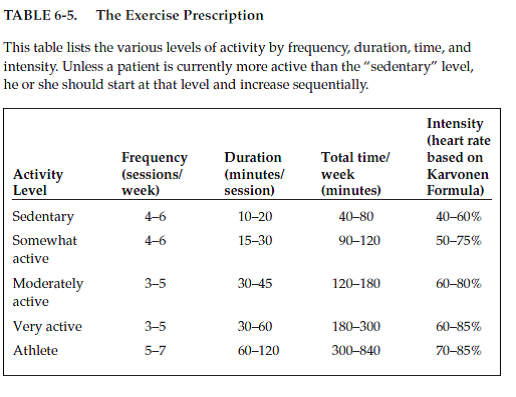
Patients should start with that level of physical exertion with the intention of slowly increasing it. People who have been physically inactive should increase the activity slowly. A gradual increase will also allow time to determine appropriate adaptations in the insulin or oral agent doses and in the meal plan in order to compensate. Table 6-5 gives estimates of various activity levels as part of an exercise prescription. Unless the patient is above the "sedentary" level at the start, he or she should begin at that level and work upward in activity level from there. The activities used for this estimation are those listed in Table 6-3.
An ultimate goal of the physical fitness program for most people should be exercising at 70% to 85% of maximal heart rate for 30 to 60 minutes, at least three to five times weekly. However, the elderly, or those with limitations due to other medical conditions, will still get some benefit from more limited physical exertion. Taking brisk walks of 30 minutes or more three times weekly can be beneficial to almost anyone.
Next Joslin excerpt: Resistance Training in Diabetes Management and Motivation
Copyright © 2010 by Joslin Diabetes Center. All rights reserved. Reprinted with permission. Neither this book nor any part thereof may be reproduced or distributed in any form or by any means without permission in writing from Joslin. Note: Joslin does not endorse products or services.
You can purchase the updated 2nd Edition of JOSLIN’S DIABETES DESKBOOK at:
https://www.joslin.org/jstore/books_for_healthcare_professionals.html
Please Note: Reasonable measures have been taken to ensure the accuracy of the information presented herein. However, drug information may change at any time and without notice and all readers are cautioned to consult the manufacturer’s packaging inserts before prescribing medication. Joslin Diabetes Center cannot ensure the safety or efficacy of any product described in this book.
Professionals must use their own professional medical judgment, training and experience and should not rely solely on the information provided in this book to make recommendations to patients with regard to nutrition or exercise or to prescribe medications.
This book is not intended to encourage the treatment of illness, disease or any other medical problem by the layperson. Any application of the recommendations set forth in the following pages is at the reader’s discretion and sole risk. Laypersons are strongly advised to consult a physician or other healthcare professional before altering or undertaking any exercise or nutritional program or before taking any medication referred to in this book.