Diabetes In Control. A free weekly diabetes newsletter for Medical Professionals. News and information for Medical Professionals.
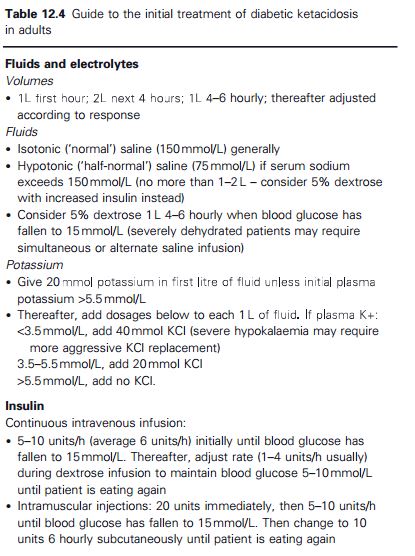
Regular/soluble insulin is usually given by continuous infusion, US guidelines suggest a dose of 0.1 unit/kg body-weight/hour. They also suggest a priming IV bolus of a similar amount but there is no evidence to suggest that this influences outcome or recovery. Alternatively, insulin can be given by hourly IM injection if there is no infusion pump available. Recently, regular SC injection of short-acting insulin analogues in a dose of 0.2 unit/kg bodyweight every 2 hours has been shown to be as effective as IV infusion in mild to moderate DKA.
The overall treatment goal is a reduction in blood glucose of no more than 3 – 5 mmol/L/h and osmolality by 3 mOsm/kg/h.
The role of intravenous bicarbonate is controversial. There is no proven benefit in patients with an arterial pH ≥ 6.9. There are good theoretical reasons why IV bicarbonate should not be given and its use has been associated with the development of cerebral oedema. The American Diabetes Association guidelines suggest 100 mmol diluted and given over 2 hours in patients with a pH < 6.9 or in whom the acidosis is felt to be contributing to their clinical status.
Although phosphate and magnesium depletion are also present, there is no evidence that routine replacement is of benefit. However, serum phosphate levels < 0.35 mmol/L can cause muscle weakness and myocardial dysfunction and need correction. Similarly, serum magnesium levels < 0.7 mmol/L should also be treated.
Complications of diabetic ketoacidosis
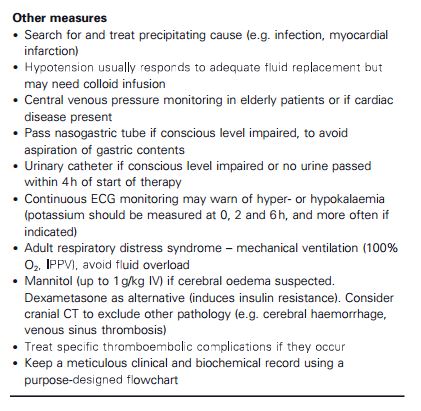
These include cerebral oedema which is a particular problem for children. This can cause ‘coning’, in which swelling of the brain within the enclosed space of the cranium forces the medulla and brainstem to herniate through the foramen magnum, leading to cardiorespiratory arrest. Cerebral oedema is often fatal, and accounts for 50% of deaths in newly presenting DKA in children. The cellular mechanisms responsible for cerebral oedema in DKA are uncertain, but clinically it is associated with rapid rehydration, a higher serum urea and lower arterial CO 2 tension at presentation and, in some cases, with IV bicarbonate replacement. It presents as a decline in conscious level, rapidly progressing to coma.
The diagnosis should be confirmed by computed tomography or magnetic resonance scanning of the brain. A reasonable treatment approach includes slowing the rate of IV fluid infusion, avoidance of hypotonic fluids, decreasing the insulin delivery rate and giving intravenous mannitol (0.2 g/kg over 30 minutes, repeated hourly if there is no improvement, or a single dose of 1 g/kg). Mechanical ventilation to remove carbon dioxide and improve acidosis has also been advocated.
Adult respiratory distress syndrome occasionally occurs in DKA, mostly in those under 50 years of age. The features include breathlessness, tachypnoea, central cyanosis and arterial hypoxia. Chest x-ray shows bilateral infiltrates which resemble pulmonary oedema. Management involves mechanical ventilation and avoidance of fluid overload.
Thromboembolism is a further potentially fatal complication usually associated with severe dehydration, increased blood viscosity and hypercoagulability. Prophylactic anticoagulation in DKA is not recommended routinely, but patients at high risk should be considered for heparin therapy.
|
LANDMARK CLINICAL TRIAL Alberti KGMM, Hockaday TDR, Turner RC. Small doses of intramuscular insulin in the treatment of diabetic coma. Lancet 1973 302: 515 – 522. This study of 14 patients with DKA (mean plasma glucose 35.4 mmol/L (637 mg/dL) and plasma ketones 12.1 mmol/L), treated with 16 units of oluble monocomponent porcine insulin IM stat followed by 5 – 10 units hourly thereafter, showed conclusively that much lower doses of insulin than were currently being used could correct DKA safely. This work built upon the observation made the previous year by Sonksen et al. that low-dose IV infusion could correct hyperglycaemia safely and gradually. Prior to this large IV boluses were given with unpredictable metabolic responses. Later that year, a study using an IV bolus of 50 units followed by a 50 unit/h infusion in 11 patients with DKA was published from the USA. A long debate ensued across the Atlantic before the principle of low-dose insulin infusion was established internationally. |
Hyperosmolar hyperglycaemic state
Hyperosmolar hyperglycaemic state (HHS) used to be called hyperosmolar non-ketotic hyperglycaemic coma, or HONK, but is now termed HHS because mild ketosis can be present and because not all patients are comatose. The diagnostic criteria are contrasted with DKA in Table 12.1 and the fluid and electrolyte deficiencies in Table 12.3. It tends to occur gradually and is often associated with drug use (notably thiazide and loop diuretics, n-blockers, steroids and major psychotropic agents). Because of its gradual onset with thirst, many patients inadvertently compound the problem by drinking fruit juices or fluids high in glucose. Precisely why ketosis is not a feature in HHS is not known but because there is only a relative deficiency of insulin, portal venous concentrations may be enough to prevent hepatic ketogenesis, but peripheral insulin levels are insufficient to stimulate glucose uptake.
Around 25% of patients with HHS have newly diagnosed diabetes. However, HHS is unusual, accounting for < 1% of hospital admissions due to diabetes in the UK. Mortality is high (5 – 20%), partly because of age and underlying cause – often cardiovascular disease or serious infection. In addiition, thromboembolic complications may occur secondary to the marked hyperosmolality and some guidelines recommend prophylactic heparinisation.
Treatment is similar to DKA, with rehydration the key. Patients may present with significant hypernatraemia (serum sodium > 150 mmol/L) in which case either 0.45% (half normal or hypotonic saline) or 5% (isotonic) dextrose can be used. The low concentration of glucose in this solution should not exacerbate hyperglycaemia which will correct more by rehydration. Only 1 – 2 litres of hypotonic saline should be used as otherwise a too rapid reduction in osmolality may cause pulmonary or cerebral oedema. Many patients can be managed ultimately without insulin once they are metabolically stable.