 Diabetes In Control. A free weekly diabetes newsletter for Medical Professionals. News and information for Medical Professionals.
Treatment of diabetic neuropathy
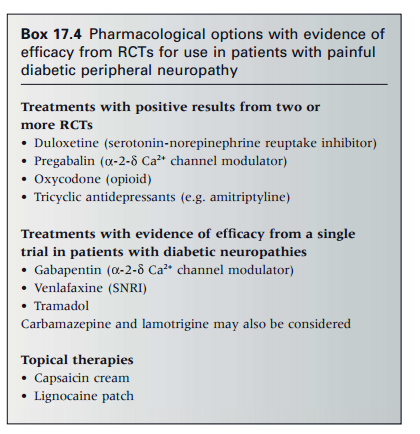
Various topical and systemic therapies have been tried for painful diabetic peripheral neuropathy, but few have been subjected to well-designed randomized controlled trials (RCTs). In addition to those listed in Box 17.4, acupuncture may be helpful and the antioxidant a-lipoic acid is used in some countries. The US Food and Drug Administration (FDA) has only licensed duloxetine and pregabalin for painful diabetic neuropathy.
| CASE HISTORY
A 55-year-old man with a 6-year history of type 2 diabetes presents to his family doctor with unpleasant symptoms of prickling discomfort, numbness and tingling over both lower limbs and feet. These symptoms often disturb his sleep, and he has noticed excessive discomfort when putting his feet into a warm bath. There are no symptoms in his hands, he is a non-smoker and drinks 6 units of alcohol per week. There are no symptoms to suggest autonomic dysfunction. He has background diabetic retinopathy, and his diabetes is managed with metformin 1 g bid and gliclazide MR 120 mg daily (HbA 1c 8.5%). Clinical examination shows some distal muscle wasting in the feet, but no ulceration. He is unable to feel the 10 g monofilament placed over the metatarsal heads. Pedal pulses are present. His height is 6’1″, BMI 29. |
Compression neuropathies
Pressure palsies comprise focal lesions of peripheral nerves that occur at sites of entrapment or compression (Figure 17.6). Diabetic nerves are thought to be more susceptible to mechanical injury. The most common is the carpal tunnel syndrome (median nerve compression), in which paresthesiae and sometimes numbness occur in the fingers and hands. Discomfort can radiate into the forearm. Examination can show wasting and weakness of the thenar muscles, with loss of sensation over the lateral three-and-a-half fingers. The diagnosis can be confirmed by nerve conduction studies. Most patients respond to surgical decompression.
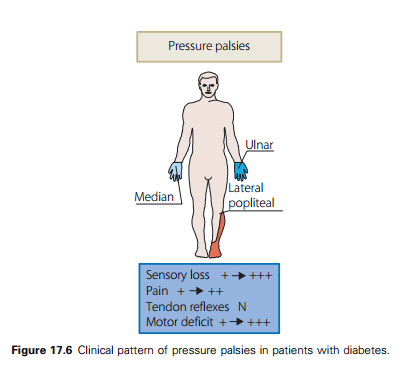
Ulnar nerve compression at the elbow causes numbness and weakness of the fourth and fifth fingers and wasting of the interossei muscles (Figure 17.7). Lateral popliteal nerve compression can cause foot drop.

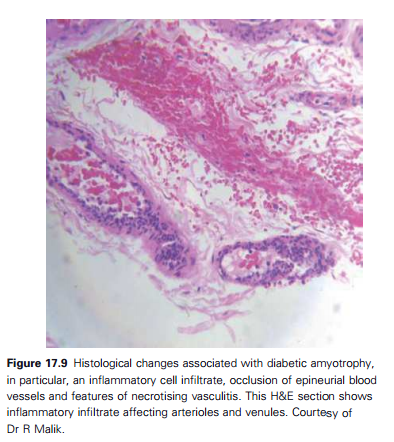
In mononeuropathies, single nerves or their roots are affected and, in contrast to distal symmetrical neuropathy, these conditions are of rapid onset and reversible, which suggests an acute, possibly vasculitic or inflammatory origin rather than chronic metabolic disturbance. The most well-known is femoral neuropathy or diabetic amyotrophy (Figures 17.8, 17.9). There is multifocal involvement of the lumbosacral roots, plexus and femoral nerve. Typically, the patient is over 50 years of age with continuous thigh pain, wasting and weakness of the quadriceps, and sometimes weight loss. The knee jerk reflex is lost.

Other mononeuropathies include cranial nerve palsies of the third or sixth nerves (causing sudden-onset diplopia). The cause is thought to be a localized infarct that involves brain-stem nuclei or nerve roots. Older people are affected mainly.