 Diabetes In Control. A free weekly diabetes newsletter for Medical Professionals. News and information for Medical Professionals.
Other markers and future research
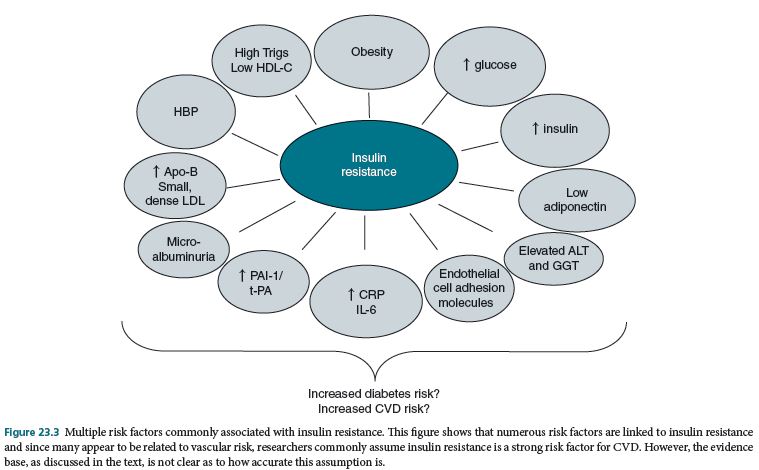
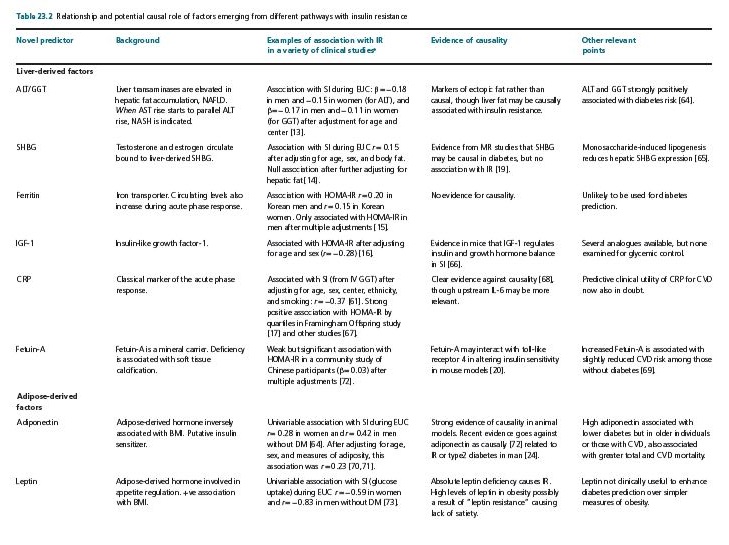
The foregoing observations have detailed the best established risk factors associated with insulin resistance (Figure 23.3) as well some novel emerging risk factors as additionally detailed in Table 23.2, including nutritional measures such as Vitamin D. These are not comprehensive but rather a selection of emerging pathways of interest. Clearly, future research should increasingly harness genetics as well as observational data to better determine causal risk pathways. Similarly, further data are needed to better determine the extent to which insulin resistance is, or is not, linked to cardiovascular risk.

Introducing insulin resistance to the clinic: the metabolic syndrome
The second section of this chapter now describes how researchers and clinicians have taken commonly measured markers associated with insulin resistance and created risk algorithms, which were subsequently tested for clinical utility.
The cluster of commonly measured risk factors for cardiovascular disease and T2DM, which are associated with insulin resistance and are recognized to commonly coexist, have become known as the “metabolic syndrome.” The concept of the metabolic syndrome was initially proposed by Reaven who suggested a conceptual framework to link these apparently unrelated clinical and biochemical characteristics [33].
What are the metabolic syndrome criteria?
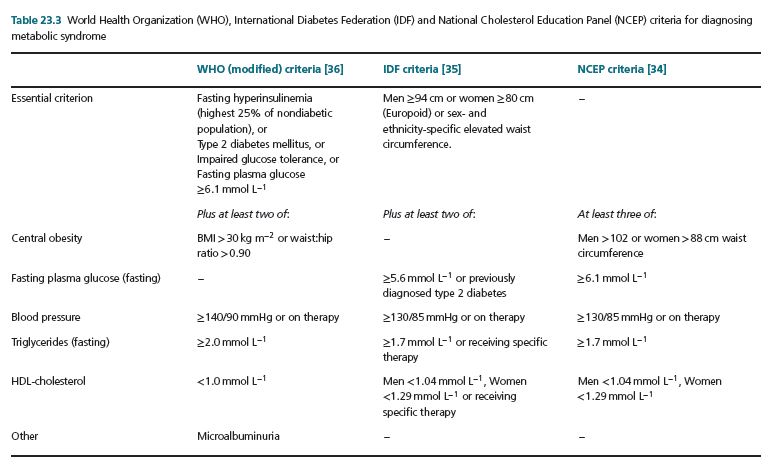
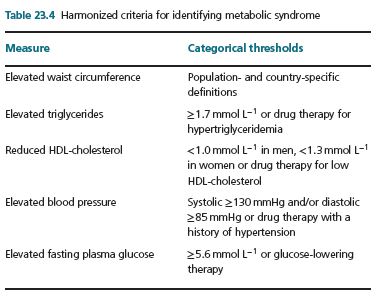
Features of metabolic syndrome include hypertension, dyslipidemia (specifically hypertriglyceridemia with low HDL-cholesterol), dysglycemia, and central obesity though it should be highlighted that the pathophysiologic basis for the association between these factors remains unidentified. Different national and international organizations have produced various overlapping but different iterations of diagnostic criteria for metabolic syndrome over the last 15 years. Early criteria from the World Health Organization (WHO), International Diabetes Federation (IDF) and National Cholesterol Education Panel (NCEP) for diagnosing metabolic syndrome are listed in Table 23.3 [34–36]. Common to all was the requirement to fulfill three out of five criteria but not all stipulated an essential criterion. For example, WHO metabolic syndrome [36] criteria required the presence of some biochemical evidence of insulin resistance or dysglycemia, to which other characteristics were then added. By contrast, IDF criteria [35] required evidence of central obesity while NCEP ATP III criteria made no such stipulation. Therefore, WHO criteria were most directly linked with Reaven’s proposed, but still unexplained, observation linking insulin resistance with hypertension and dyslipidemia as an explanation for the excess cardiovascular risk in diabetic patients. One immediate practical difficulty was the fact that fasting insulin levels were seldom measured in a routine clinical setting and that a definitive insulin resistance diagnosis was poorly defined.Therefore the change in focus of the IDF criteria to central obesity rendered these criteria not only easier to assess, but also raised awareness of obesity as being a key player in the majority at risk of developing T2DM. The IDF and NCEP criteria were also very easily applied to many existing large epidemiologic studies, leading to the publication of huge swathes of epidemiologic research of variable quality over the last two decades exploring the clinical utility of metabolic syndrome. Importantly, the availability of various criteria for identifying metabolic syndrome and the knowledge that the relationship between risk of cardiometabolic disease and central obesity varies according to ethnic group led to confusion in clinical practice and controversy in published literature, though controversy has not been limited to this specific issue. To address recognized shortcomings, a harmonized set of criteria was produced by a working group on behalf of the International Diabetes Federation Task Force on Epidemiology and Prevention, the National Heart, Lung, and Blood Institute, the American Heart Association, the World Heart Federation, the International Atherosclerosis Society, and the International Association for the Study of Obesity in 2009 [37] (see Table 23.4). As in previous criteria, three out of five criteria are now required to be identified as having metabolic syndrome. However, the presence of central obesity as an essential criterion was removed with the result that the presence of any three criteria now constitutes a diagnosis of metabolic syndrome. Furthermore, flexibility has been introduced into the definition of metabolic syndrome as population- and country-specific definitions for elevated waist circumference are required, reflecting the understandable lack of agreement on how best to record and define central obesity. Suggested current thresholds for elevated waist circumference, as recommended by various organizations, are provided in the document (see also Table 23.5). The authors propose that further research is required to properly delineate the relationship between waist circumference and cardiometabolic risk in all ethnic groups and suggest that particular health systems may even base the choice of waist circumference threshold on local considerations, including healthcare funding.
The purpose of the metabolic syndrome concept
The purpose behind introduction of the metabolic syndrome into clinical practice and published epidemiologic research appears to have been the desire to facilitate identification of those at risk of experiencing a cardiovascular event and/or developing T2DM in the medium to long term using a simple tool. Rationale for using metabolic syndrome has been summarized as: (i) facilitating research into a possible unifying pathophysiologic explanation for these strongly associated risk factors, (ii) quantifying chronic disease risk and allowing between-country comparison, (iii) guiding clinical management decisions, and (iv) providing an easily understood public health message [38]. Those involved in developing and promoting the concept of the metabolic syndrome have described it as a potentially valuable global public health tool with the ability to identify high-risk individuals at a young age. Undoubtedly, one positive effect of the adoption of the term has been to familiarize healthcare professionals with the potentially deleterious effects of obesity and to provide an easily understood term, or clinical label, to describe a commonly encountered type of patient. Furthermore, appreciation of those with metabolic syndrome has likely raised the profile of lifestyle advice and increased the provision of advice to those at risk of developing diabetes.
 The clinical utility of metabolic syndrome has been controversial, however, with proponents arguing that identifying a patient with metabolic syndrome is a simple and effective method to identify someone at potentially long-term risk of cardiometabolic risk [39] but with skeptics arguing that the label of “metabolic syndrome” adds little to established methods for risk calculation for cardiovascular disease and T2DM [40–42]. Some key topics of debate have been the presence of various differing sets of criteria, now addressed by the introduction of the harmonized criteria already referred to, and the fundamental question of the role and value of metabolic syndrome in clinical practice. It is this latter point that remains unresolved. Some of the more humorous and incisive pieces in the medical literature in recent years have addressed this matter [43–45].
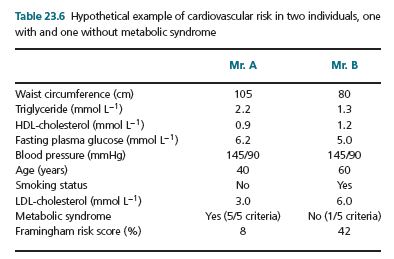
Since the introduction of the Framingham Risk Score (based on classical cardiovascular risk factors namely hypercholesterolemia, hypertension, smoking), supplemented more recently with ever better performing risk scores in the United Kingdom such as QRISK2 [46] and ASSIGN [47] which incorporate additional risk factors like family history and social deprivation, clinicians have had at their disposal effective tools for prediction of cardiovascular events thereby facilitating allocation of effective risk-lowering therapies to those at highest risk. The presence of metabolic syndrome is itself unequivocally associated with increased risk of cardiovascular disease, as confirmed in various studies [48–50], but this is unsurprising given that it includes some powerful cardiovascular risk factors, namely hypertension and low HDL-cholesterol. In the view of many, the key question has therefore been whether identifying a patient as having metabolic syndrome yields additional predictive information on top of these risk scores. In other words, to be of clinical value, any new risk predictor must be more effective than current risk predictors to demonstrate clinical utility. It has now been well demonstrated that identification of metabolic syndrome cannot compete with the cardiovascular predictive capabilities of established cardiovascular risk scores and also that it adds minimal incremental information [51–53]. This apparent under-performance is unavoidable given the necessary absence of three of the strongest known cardiovascular risk factors namely age, low-density lipoprotein (LDL) cholesterol, and smoking status. To illustrate this problem with a clinical example, two theoretical but commonly encountered patients are listed in Table 23.6 (as previously described [42]).
Although both are hypertensive, only Mr. A fulfills all criteria for metabolic syndrome (5/5), unlike Mr. B. Nonetheless, Mr. B is at considerably greater risk of vascular disease due to his older age, his higher LDL-cholesterol, and his smoking status. In addition, individual components of the metabolic syndrome often outperform the overall metabolic syndrome unlike established cardiovascular risk scores [54–56].
Where metabolic syndrome arguably makes a stronger case for routine clinical use is in the prediction of developing T2DM, as demonstrated in previous epidemiologic studies [49,57] and in keeping with Reaven’s proposed unifying hypothesis, insulin resistance.Three of the five variables in the metabolic syndrome criteria are more strongly linked to diabetes than cardiovascular disease, namely elevated triglycerides, central obesity, and dysglycemia. As an example, the Emerging Risk Factors Collaboration’s (ERFC) comprehensive analysis established that impaired fasting glycemia is only weakly associated with incident cardiovascular events [58]. By contrast, IFG’s association is an order of magnitude more powerful with risk of developing diabetes than with risk of cardiovascular disease [59]. The cases of BMI and hypertriglyceridemia are analogous. Regardless, knowledge of an individual’s fasting blood glucose provides at least the same predictive information as knowledge of metabolic syndrome status for identifying those most likely to develop T2DM.