 Diabetes In Control. A free weekly diabetes newsletter for Medical Professionals. News and information for Medical Professionals.
- Anxiety and Depression May Increase Mortality Risk in Type 2 Diabetes
- Periodontitis Linked to Diabetes Mellitus
- Innovative Glucose Sensing Device In Type 1 Diabetes Patients With Hypoglycemia
- Low Magnesium Can Increase Risk of Prediabetes
- Potential Risks Associated With Fluid-Filled Intragastric Balloons
- Hypoglycemia in Type 1 Diabetes Associated with Proarrhythmogenic Effects
Letter from the Editor
 Sometimes you learn things from your interns that you never forget. About eight years ago, I was working with a diabetes patient in a physician’s office. The patient was on three times the normal dose of potassium, but their levels were still low. One of my interns looked at the labs and let me know that if your magnesium is low, it is difficult to keep your potassium levels anywhere near normal. We started the patient on MagOx 400 and within 30 days, potassium levels were normal.
I never forgot that lesson and when I started cycling, daily magnesium became a part of my regimen. Now new research that we have in Item #4 is showing that low magnesium levels may increase the risk of prediabetes and diabetes in patients with certain gene variants. It’s another good reason to make sure your patients’ levels are good.
*****************************
We can make a difference!
*****************************
Dave Joffe
Editor-in-chief
This Week's Survey
Do you use the NovoFine Autocover disposable safety needle system in your hospital or practice? (If so, see this week’s Did You Know.)
Tool: Insulin Pocket Chart
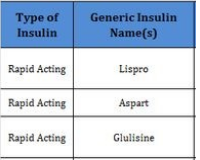 A pocket chart of insulin products available and defined according to name, manufacturer, route of administration, derivation, onset, peak, and duration of action. Diabetes In Control Insulin Pocket Chart (PDF)
Test Your Knowledge
In a survey with medical professionals, 78% got this wrong. Can you do better?
According to the Centers for Disease Control and Prevention, what percentage of patients who have diabetes and are older than 65 y will die of heart disease?
A. 58%
B. 68%
C. 78%
D. 88%
Follow the link to see if you got the right answer!
Did You Know: Major Error in Teaching Patients How to Use an Insulin Pen
I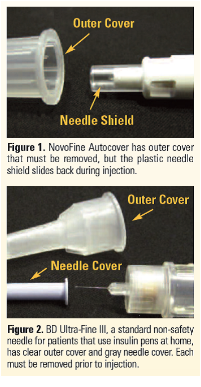 ndividuals who teach patients with diabetes about insulin, particularly how to use insulin pens, need to be aware of an unusual situation that can happen once patients become familiar with the NovoFine Autocover disposable safety needle system that is used in many hospitals. With this needle system (Figure 1), the user holds the outer cover of the needle system while it is screwed onto the insulin pen. The outer cover is then removed, exposing a plastic needle shield that is over the needle. As the device is held against the skin, the needle shield slides back and allows the skin to be punctured and the insulin is injected. Once the injection is complete, the shield slides back over the needle as it is removed from the skin and locks in place so the needle cannot be used again.
The Autocover system is quite different from standard insulin pen needles that patients purchase at their pharmacy, which do not employ a needle shield. However, these two needle systems can look similar, and patients may not recognize the difference. Both the Autocover and standard needle systems have an outer cover that, when removed, exposes either a retractable needle shield (Autocover device, Figure 1) or a needle cap (standard system, Figure 2). The Autocover needle shield is not intended to be removed prior to injection, but the needle cap on the standard system must be removed before the injection to allow administration of insulin.
Recently, a hospitalized patient was receiving new insulin therapy with a NovoFine Autocover needle attached to the pen. Nurses and a certified diabetes educator (CDE) taught the patient how to use the insulin pen at home and instructed the patient to perform blood glucose testing four times a day. The hospital conducted home visits after discharge, and the patient reported elevated blood glucose levels to the nurse during a visit. When the nurse investigated, she realized the patient was not removing the cap from the pen needle because she thought it was the same safety needle used during her hospitalization. Consequently, she was not receiving any insulin since the needle never punctured the skin. We first published an alert about this in our February 26, 2009 newsletter. Patients who use Autocover devices in the hospital and then switch to standard pen needles at home must be made aware that there are two types of needle systems for pens. If they are using standard needles, they need to know to remove both caps. The hospital that reported the latest event has changed to non-safety needles when training patients to make sure they know how to administer insulin with the pen and needle they will use at home. All hospitals should verify which needle the patient will be using upon discharge and tailor the training to that needle whenever possible. If blood glucose levels are elevated after injection, the patient should be reminded to consult a diabetes educator or physician, who should review the injection technique with the patient. Community pharmacists dispensing pen supplies should also educate patients regarding their proper use, and patients should question if the needle is not what they expect. — ISMP.org (Institute for Safe Medicine Practices)
Symptoms of anxiety found to be independent of symptoms of depression
Dental practices should focus on patients with severe periodontitis for screening of prediabetes
Safety and effectiveness of FreeStyle Libre glucose-monitoring system
Low serum magnesium partly mediated through insulin resistance
Is procedure worth associated acute pancreatitis or spontaneous over-inflation?
Arrhythmia incidents differ in nocturnal and diurnal hypoglycemic patients.
Quote of the Week!
“Good health is not something we can buy. However, it can be an extremely valuable savings account.”
…Anne Wilson Schaef
Your Friends in Diabetes Care
Steve and Dave
Diabetes In Control
810 Bear Tavern Road Suite 102
Ewing, NJ, 08628
USA
www.diabetesincontrol.com