 Diabetes In Control. A free weekly diabetes newsletter for Medical Professionals. News and information for Medical Professionals.
- What Happens When You Have Two SGLT Inhibitors: SGLT-1 + SGLT-2 = ?
- Semaglutide Shows Benefits for Type 2s
- FDA Approves Trulicity® Once Weekly Use In Combo With Daily Basal and Rapid Insulins
- Uncommon Side Effect of SGLT-2 Inhibitors
- The Future For Insulin Pump Companies: Who Will Survive?
-
Guest Post by David Kliff, Diabetic Investor
-
- Effectiveness of A GLP-1 Inhibitor Plus A TZD for Type 2 Diabetes
Letter from the Editor

Sometimes it takes a while to find the missing link when it comes to patient care. When insulin was first used in the 1920s, it was viewed as a cure for diabetes. But as hard as we tried using insulin, we never got to good glucose levels. In the late 40’s, researchers found that the liver played a big part in diabetes, and a decade later Metformin became available for those patients.
Since that time, we have added significant new diabetes medications and care has improved. In fact, now the choices are so plentiful it is often hard to match the right ones together. The knowledge we have about these medications has also improved and we can see when it isn’t as effective as we would assume it to be. This is the case when it comes to the SGLT-2 Inhibitors.
Researchers have spent years figuring out why these drugs only reach about half their potential effect, and this week the mystery is solved. Check out Item 1 to find the solution.
- In case you missed it: dMeetings is a new way to educate your diabetes patients that gives them the freedom to learn at their own pace from knowledgeable certified educators. To learn how to get started with dMeetings, see our recent New Product item.
*****************************
We can make a difference!
*****************************
Dave Joffe
Editor-in-chief
This Week's Survey
When was the last time you rode a bike?
a) Days
b) Weeks
c) Months
d) Years
e) Decades ago
f) Never!
Follow the link to see how you compare to your colleagues!
Newsflash: J&J (Animas & Lifescan) Wants Out of Diabetes Market
Test Your Knowledge
GLP-1 receptor agonists vs DPP-4 inhibitors: In head-to-head trials of dipeptidyl peptidase 4 (DPP-4) inhibitors vs glucagon-like peptide 1 (GLP-1) receptor agonists, GLP-1 receptor agonists showed more favorable outcomes in all of the following areas except which one of the following?
A. Greater glycemic control
B. Greater tolerability
C. Greater weight loss
D. Greater improvement in beta-cell function
E. Greater reduction in postprandial triglycerides
Follow the link to see if you got it right!
Fact: The One-Minute Workout of Stair Climbing Makes A Difference
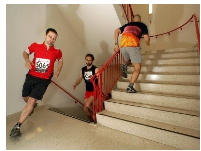 Couch potatoes now have no excuse to forego exercise. A new study suggests brief but intense stair climbing, which can be done anywhere, is just as good for the heart as structured physical activities. A team of researchers found that stair climbing is a convenient and easy way to fit exercise into your life. The study negates two common excuses of couch potatoes: no access to the gym and no time to visit one. Kinesiology professor Martin Gibala, lead author, said stair climbing is a kind of exercise that anyone can do after work or during lunch hour. “This research takes interval training out of the lab and makes it accessible to everyone,” he said. Gibala is an expert at high-intensity interval training and author of a book called The One-Minute Workout. Past studies have shown that vigorous stair climbing accumulated over long periods of time — about 70 minutes in seven days — can have positive benefits.
Researchers set out to investigate whether sprint interval training (SIT) is a time-efficient and effective alternative that improves heart health. SIT involves brief bursts of intense exercises separated by short periods of break. The first procedure involved three bouts of continuous climbing that lasted for 20 seconds. The results of this first procedure were compared among women who ran through the same procedure but with an exercise bike that has been proven to improve fitness. During the second procedure, participants vigorously climbed up and down one flight of stairs for 60 seconds — an experiment that can be performed at home. Both protocols, which lasted for 30 minutes, increased the cardiorespiratory fitness of the participants, which is an important health marker for longevity. Medicine & Science in Sports & Exercise: February 2017 – Volume 49 – Issue 2 – p 298–307
New dual drug could be a diabetes breakthrough.
Current study in Lancet showed that patients reduced their A1c levels by 1.55%.
Only GLP-1 receptor agonist for use with mealtime or basal insulin for adults with type 2.
Even though amputation is not a major effect, it is still important to let patients know about it and how to prevent it with proper foot care.
As problems for Tandem continue, and with Johnson & Johnson abandoning the insulin pump market, it’s beginning to dawn on some people that we soon could live in a world with just two insulin pump companies – Medtronic and Insulet.
Therapy said superior to a basal/bolus insulin regimen at lowering HbA1c with less hypoglycemia and weight gain.