 Diabetes In Control. A free weekly diabetes newsletter for Medical Professionals. News and information for Medical Professionals.
Stepwise dose increases were used in both groups to a maximum 20 µg/day. The primary objective was to demonstrate non-inferiority of lixisenatide vs. exenatide for HbA1c reduction at Wk 24 (predefined non-inferiority margin 0.4%). Hereafter, the 24-wk main treatment period data are presented.
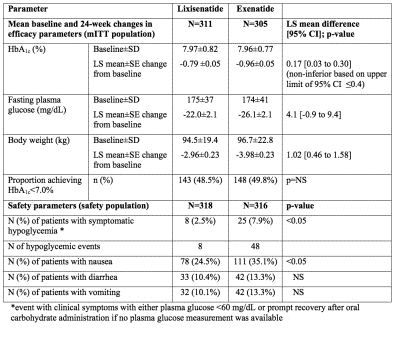
Lixisenatide QD achieved its primary endpoint of non-inferiority in HbA1c reduction vs. exenatide BID (Table). Improvements in mean FPG and the % patients achieving HbA1c <7.0% were comparable between groups (Table). Mean body weight significantly decreased from baseline: 94.5 to 91.7 kg with lixisenatide and 96.7 to 92.9 kg with exenatide. The proportion of patients with AEs and serious AEs was generally comparable between the lixisenatide and exenatide groups. Discontinuations due to AEs (mainly GI events) were 33 (10.4%) lixisenatide and 41 (13.0%) exenatide. Significantly fewer patients experienced symptomatic hypoglycemia with lixisenatide, with 6-fold fewer hypoglycemic events (Table). No severe episodes were reported.
Overall GI tolerability appeared better for lixisenatide vs exenatide, with fewer cases of nausea and vomiting (Table). More lixisenatide patients tolerated the target dose of 20 µg/day (93% vs.83% exenatide). In conclusion, as add-on to metformin, lixisenatide QD was non-inferior to exenatide BID at improving HbA1c, but with less hypoglycemia, slightly less weight loss and better GI tolerability at Wk 24.[figure1]
Authors: JULIO ROSENSTOCK, DENIS RACCAH, LASZLO KORANYI, LAURA MAFFEI, GABOR BOKA, PATRICK MIOSSEC, JOHN E. GERICH- ADA Scientific Sessions Late Breaking Abstract Sunday, June 26, 2011 Abstract -33LB