 Diabetes In Control. A free weekly diabetes newsletter for Medical Professionals. News and information for Medical Professionals.
- Updated Patient-Centered Hyperglycemia Guidelines for 2018
- Dementia Risk for People Who Have Type 1 Diabetes
- Sotagliflozin Shows Promise As Adjunct To Insulin Therapy
- Glargine 300 units/mL Versus Degludec 100 units/mL
- How Effective Are Statins for Patients 75 and Older?
- Proteins Predict Progression and Mortality of Kidney Disease
Letter from the Editor

This week we have some great information on new ADA and EASD guidelines for treating type 2 diabetes. The focus is once again on individualized treatment and increased usage of newer medications. This goes along with a study published in Lancet Diabetes Endocrinology for using medications to prevent diabetes. All of these ideas mean that it will likely cost more in the future to treat our patients. This has led to a cry by our political leaders to rein in drug costs and make pricing more transparent.
One of the things that will likely be of benefit to our Medicare eligible patients — and was included in President Trump’s budget bill signed earlier this year — is the closing of the donut hole a year earlier, by requiring pharma to pay a bigger share (10% more) of patient’s drug costs.
Part D enrollees will receive a 75% Donut Hole discount on the total cost of their brand-name drugs purchased while in the Donut Hole. The discount includes a 70% discount paid by the brand-name drug manufacturer and a 5% discount paid by your Medicare Part D plan. The 70% paid by the drug manufacturer, combined with the 25% they pay, count toward your TrOOP or Donut Hole exit point. (This was to have been only 60% paid by manufacturer prior to change.)
For example: If you reach the Donut Hole and purchase a brand-name medication with a retail cost of $100, you will pay $25 for the medication, and receive $95 credit toward meeting your 2019 total out-of-pocket spending limit.
Medicare Part D beneficiaries who reach the Donut Hole will also pay a maximum of 37% co-pay on generic drugs purchased while in the Coverage Gap (receiving a 63% discount). For example: If you reach the 2019 Donut Hole, and your generic medication has a retail cost of $100, you will pay $37. The $37 that you spend will count toward your TrOOP or Donut Hole exit point.
CMS has indicated that this will help many patients get through the donut hole with approximately 30% less out of pocket costs. Please be reminded that once a patient moves through the donut hole into catastrophic coverage their copay on all brand medications is only $6.60 per prescription.
*****************************
We can make a difference!
*****************************
Dave Joffe
Editor-in-chief
This Week's Survey
From your experience, which is the best way to educate your patients who have type 2 diabetes and do not take insulin?
– Individual personal classes
– Group classes
– Online classes
– Recommend a book
– Brochures and pamphlets
Follow the link to share your experience.
Newsflash: Minnesota Becomes First State to Sue Major Insulin Makers Over Price-Gouging
 The Minnesota attorney general recently filed a lawsuit accusing the three largest manufacturers — Eli Lilly, Sanofi, and Novo Nordisk — with deceptively raising prices. They become the first state to go to court over the issue.
Newsflash: Positive Cardiovascular Safety Data Added to Saxenda Label
Novo Nordisk today announced that the U.S. Food and Drug Administration (FDA) approved an updated label for Saxenda® (liraglutide) injection 3 mg, which is the first and only FDA-approved medicine in a pen indicated to help adults lose weight and keep it off. The label now includes some data from the landmark LEADER trial (NCT01179048) that show the same active ingredient found in Saxenda, at a lower dose, liraglutide 1.8 mg, did not increase the risk of major adverse cardiovascular (CV) events, (non-fatal heart attack, non-fatal stroke and CV death) in adults with type 2 diabetes and established CV disease. See the Novo Nordisk press release for more info.
New Product: PumpPeelz
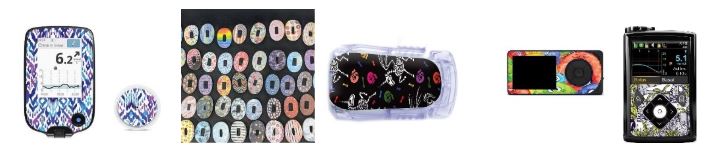
Em ily and Scott Imblum are the makers of latest stickers designed to help people with diabetes express themselves. PumpPeelz.com is a diabetes accessories retailer that provides a fun and engaging product for consumers. The stickers are for insulin pumps, monitors, lancet devices, and CGMs and sensors. For our readers, we have set up a 30% discount and the coupon code is “DiabetesinControl” or just go to this link and your discount will be applied automatically at checkout: Pumppeelz.com. If you are a medical professional, you can request samples by reaching out to hello@pumppeelz.com and reference this post from Diabetes In Control.
Test Your Knowledge
Which of the following is true regarding the epidemiology of hypertriglyceridemia?
A. Triglyceride levels increase gradually in women until about age 50 years and then decline slightly.
B. Triglyceride levels in men continue to increase with age.
C. Mild hypertriglyceridemia (triglyceride level greater than 150 mg/dL) is slightly more prevalent in women beginning at age 30 years and in men at the age of 60 years.
D. Non-Hispanic black persons often have lower triglyceride levels than white persons.
Follow the link for the answer.
Did You Know: Preventing T2D For Patients With Prediabetes: To Treat or Not to Treat
Of the 84 million American adults who have had prediabetes for over five to seven years, about 28 million progress to having type 2 diabetes. Progression to type 2 diabetes (T2D) in people at high risk can be reduced with interventions that correct underlying insulin resistance and/or impaired beta-cell function. In a new retrospective observational study of people at increased risk for T2D, an OGTT was used to assign risk stratification based on severity of insulin resistance, impaired beta-cell function, and blood glucose. There were three treatments that consisted of:
- metformin, pioglitazone (Actos), glucagon-like peptide-1 receptor agonist (GLP-1RA), and lifestyle therapy for 81 patients who are at high risk;
- the same minus GLP-1RA for 141 with intermediate risk; and
- lifestyle only for 200 refusing pharmacologic treatment (76 high-, 124 intermediate-risk).
During a mean 32-month follow-up, annual T2D incidence was:
- 4.1% with lifestyle only;
- 1.7% for metformin/pioglitazone; and
- 0% for metformin/pioglitazone/GLP-1RA.
From the results of this study, one may conclude that progression to type 2 diabetes in people at high risk of diabetes can be markedly reduced with interventions designed to correct underlying pathophysiological disturbances (i.e., impaired insulin secretion and resistance) in a real-world setting.
Reference: Armato JP, DeFronzo RA, Abdul-Ghani M, Ruby RJ. Successful treatment of prediabetes in clinical practice using physiological assessment (STOP DIABETES). Lancet Diabetes Endocrinol. 2018 Sep 13 [Epub ahead of print]. doi: 10.1016/S2213-8587(18)30234-1. PMID: 30224284
Holistic approach revised, but there is still more to be done to individualize treatment.
A1c management over longer periods shown to decrease likelihood of diagnosis.
New SGLT1/SGLT2 inhibitor lowers HbA1c and has less hypoglycemia episodes among people who have type 1 diabetes.
Two long-acting insulin analogs are compared for efficacy and side effects.
Current therapy recommendations may need adjustment.
Researchers develop way to measure abundance of 12 different complement proteins in the urine.
Quote of the Week!
“Think like a queen. A queen is not afraid to fail. Failure is another stepping stone to greatness.”
…Oprah Winfrey
Diabetes in Control gratefully acknowledges the assistance of the following pharmacy doctoral candidates in the preparation of this week’s newsletter:
Angela Reyes, Pharm.D. Candidate, LECOM College of Pharmacy
Arsalan Hashmi, PharmD. Candidate, LECOM College of Pharmacy
Your Friends in Diabetes Care
Steve, Dave, and Joy
Diabetes In Control
810 Bear Tavern Road Suite 102
Ewing, NJ, 08628
USA
www.diabetesincontrol.com