 Diabetes In Control. A free weekly diabetes newsletter for Medical Professionals. News and information for Medical Professionals.
- Glucose Self-Monitoring For Non-Insulin Using Patients Did Not Improve Control
- ADA: Oral Insulin May Delay Type 1 Diabetes Onset
- ADA: Broiling, Barbecuing and Roasting Meat May Increase Risk of Diabetes
- Statins and Exercise: Revisited
- by Sheri R. Colberg, PhD
- Current Interview: Dr. Steven Edelman on Adherence and Persistence in Type 2 Medications
Letter from the Editor
 It is not how often you take your glucose, but rather when you take your glucose reading, that makes the biggest difference. For many years the standard of care has been for an orally medicated patient to check their glucose when they first get up in the morning.
Two things occur when your patients do that. First, they see almost the same readings every day, so they likely quit checking; and secondly, they never see how high their levels really get. Now there is a new JAMA study that states that monitoring in non-insulin using patients does not improve outcomes.
To see why this result occurred check out Item One, and find out why this article got our publisher’s blood boiling when he read it.
*****************************
We can make a difference!
*****************************
Dave Joffe
Editor-in-chief
Newsflash: TCOYD's "ONE" Event Held in San Diego
Taking Control Of Your Diabetes (TCOYD) recently held their “ONE” event, a conference and retreat for adults with type 1 diabetes, in San Diego. Over 500 attendees came to the conference and retreat from 205 cities. The event is the vision of Dr. Steven Edelman, the subject of our interview this week. To learn more about TCOYD’s events for diabetes patients, HCPs and educators, click here.
This Week's Survey
How often do you recommend to your patients with type 2 who do not take insulin that they monitor their blood glucose?
1) Once daily in the AM
2) Twice daily in the AM and after 1 meal
3) 3 or 4 times daily 2 to 3 times a week
4) Other
Follow the link to see how you compare to your colleagues.
New Product: Accu-Chek’s New More Accurate and Less Expensive Strips
Th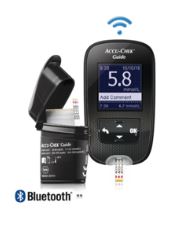 e new blood glucose meter also uploads readings to smartphones.
The Accu-Chek Guide blood glucose meter from Roche is now available in the U.S., featuring Bluetooth integration with smartphone apps, new highly accurate strips, and a new SimplePay savings card to save money and get a free meter. Most notably, Roche has significantly dropped the price of strips for those paying cash (without insurance): the first vial of 50 strips costs $19.99, and each additional 50 strips cost an extra $10. That means $29.99 for 100 strips and $39.99 for 150 strips, all the way up to $129.99 for 600 strips. The strips are also highly accurate, as 95% of measured glucose values fall within 10% or 10 mg/dl of the lab reference value – far better than many meters. Blood can be applied anywhere on the end of the strip, rather than only to a narrow fill window. On the design front, the no frills Bluetooth-enabled meter uploads readings to the Accu-Chek Connect smartphone app (available for iOS and Android devices), which features a built-in bolus advisor once activated by a healthcare provider.
Current Interview
Dr. Steven Edelman, MD, brings his research on the topic of adherence and persistence in type 2 medications.
Test Your Knowledge
A 62-year-old man presents with type 2 diabetes, hypertension, and albuminuria. His seated BP is 162/104 mm Hg. What’s an ideal blood pressure target for this patient?
A. 140/90 mm Hg
B. 130/80 mm Hg
C. 120/70 mm Hg
D. 150/80 mm HG
Follow the link to see the correct answer.
Did You Know: Broccoli Can Help Fight Diabetes
According to a new study, an antioxidant found in broccoli, called sulforaphane, may provide a new option for treating type 2 diabetes. They identified a substance called sulforaphane that showed it could reduce the exaggerated glucose production from the liver, which is a central mechanism in type 2 diabetes. They used highly concentrated broccoli extract, which would be equivalent to eating about 5 kg of broccoli per day. When it was given to patients and they measured their glucose control before and 12 weeks after treatment, there was significant improvement in fasting blood glucose and HbA1c in obese patients. Sulforaphane was used in a double-blind placebo-controlled randomized trial in humans with type 2 diabetes. All participants were taking metformin — 60 had well-regulated diabetes while 37 had dysregulated diabetes (20 nonobese, 17 obese). Participants were randomized to broccoli extract or placebo for 12 weeks. In the broccoli-extract group HbA1c levels decreased significantly after 12 weeks (P = .004), while the placebo group showed no difference from baseline (P = .5). The participants who started the study with dysregulated diabetes showed significantly reduced fasting blood glucose with broccoli extract compared with placebo (P = .023). And specifically in the obese patients with dysregulated diabetes who received broccoli extract, both fasting blood glucose and HbA1c significantly decreased compared with placebo (P = .036, and P = .034, respectively). Some patients experienced gastrointestinal discomfort and flatulence. But these symptoms disappeared after the first few days, and there was no significant difference in adverse effects between the broccoli-extract group and placebo. They now plan to test the extract in prediabetes to see whether the extract can help prevent diabetes developing. Further studies are needed, however, before broccoli extract can be recommended for patients. — Sci Transl Med. Published online June 24, 2017. Abstract
The value of self-monitoring of blood glucose (SMBG) levels in patients with non-insulin-treated type 2 diabetes has been debated over the years.
In adults with two or more antibodies predicting the development of type 1 diabetes, treatment with daily oral insulin therapy did not prevent development of the disease, but a small subset experienced a 31-month delay in clinical diabetes development.
Chemicals such as heterocyclic amines (HCA) and polycyclic aromatic amines (PAH) found in overcooked meat play a role in the development of type 2 diabetes (T2D).
I chronicled someone with type 1 diabetes whose ability to exercise was compromised by his use of statins back in April 2016. As you know, statins are a class of medications prescribed to lower cholesterol levels or abnormal levels of blood fats, with the goal being a reduction in the risk of heart attack and stroke. Brand name examples of statin medications include Altoprev, Crestor, Lescol, Lipitor, Livalo, Mevacor, Pravachol, and Zocor.
Quote of the Week!
“The good physician treats the disease; the great physician treats the patient who has the disease.”
…William Osler
Diabetes in Control gratefully acknowledges the assistance of the following pharmacy doctoral candidates in the preparation of this week’s newsletter:
Nuha Awad, Doctor of Pharmacy Candidate, ACCP|FSHP
Priscilla Rettman, PharmD Candidate, Philadelphia College of Osteopathic Medicine- GA Campus
Your Friends in Diabetes Care
Steve and Dave
Diabetes In Control
810 Bear Tavern Road Suite 102
Ewing, NJ, 08628
USA
www.diabetesincontrol.com