Mar 10, 2018
Letter From The Editor
2,429 views
I recently converted one of my aero road bikes from a 22-speed to a single speed, which means I only have one gear. I can still get up to 27 mph on a sprint, but instead of pedaling at 80 revolutions a minute, I am forced to pedal at 123 …
Read More »
Mar 10, 2018
Articles, Cardiology
3,821 views
Study finds disease duration in middle age to be independently related to development of subclinical atherosclerosis and cardiac dysfunction later in life.
Read More »
Mar 10, 2018
Articles, Blood Glucose Control, Type 2 Diabetes
14,013 views
Organization says adults with type 2 diabetes can aim for an easier-to-achieve blood sugar target than what’s been used to guide treatment in the past.
Read More »
Mar 10, 2018
Articles, Diet & Nutrition, Pediatrics, Type 1 Diabetes
3,326 views
An attempt to improve diet quality in youth with type 1 yields less than promising results.
Read More »
Mar 10, 2018
Articles, Type 2 Diabetes
3,663 views
While detection of type 2 diabetes for specific subgroups in the population has slightly increased, overall detection rates remain low among US adults.
Read More »
Mar 10, 2018
Articles, Blood Glucose Control, Cardiology
6,419 views
When added to statin therapy in patients with diabetes, ezetimibe provides greater cardiovascular protection than what is seen in individuals without diabetes.
Read More »
Mar 10, 2018
Articles, Metformin Therapy Center, Obesity, Pediatrics
4,868 views
Long-term impact of intrauterine exposure to medication on the offspring remains unclear.
Read More »
Mar 10, 2018
Test Your Knowledge
2,502 views
A patient that you haven’t seen for several years comes to your clinic for a wellness check-up. Since her last visit, she has gained about 15 pounds (5’6”, BMI 27 kg/m2). Her stage 1 hypertension is controlled with hydrochlorothiazide. As you discuss her weight gain, you learn that she doesn’t get more than 30 minutes a week of physical activity. You decide it would be best to check her A1C. Which of the following information from her history leads you to screen her for type 2 diabetes?
A. Her youngest child weighed 8.5 pounds at birth.
B. Two of her cousins have type 2 diabetes.
C. She just celebrated her 41st birthday.
D. She has a history of hypertension.
Follow the link for the answer.
Read More »
Mar 10, 2018
Polls
2,543 views
The American College of Physicians (ACP) said doctors can tell patients to aim for a glycosylated hemoglobin, or HbA1C, level between 7 percent and 8 percent, rather than the traditional 6.5 percent to 7 percent. Plus, clinicians should consider deintensifying pharmacologic therapy in patients with type 2 diabetes who achieve HbA1c levels less than 6.5%. (See article 2)
Do you agree A1c should be between 7% and 8%?
Follow the link to see what your colleagues think.
Read More »
Mar 10, 2018
Clinician Mobile Apps
8,821 views
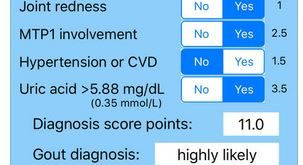
Gout is a tricky diagnosis to make. Rarely is it made via the gold standard technique of synovial aspiration and polarized light microscopy. The vast majority of diagnoses are clinical. A primary care and rheumatologist team of Dutch researchers led by Hein Janssens derived and published a clinical decision rule in 2010. This app brings that decision rule to primary care physicians, rheumatologists, and acute care (ER/urgent-care) clinicians everywhere.
Read More »
 Diabetes In Control. A free weekly diabetes newsletter for Medical Professionals. News and information for Medical Professionals.